
Quick Answer
AI tools for content writing are platforms that use artificial intelligence to generate, edit, and optimize text. These tools help automate manual writing tasks, improve output quality, and enable content creators to produce articles at scale with better efficiency.
Content creation looks effortless on the outside, but behind the scenes, it’s a daily battle—tight deadlines, blank-page syndrome, and the endless grind of brainstorming ideas. Whether you’re a blogger, content marketer, or run a WordPress site, it’s easy to feel swamped. The reality is that keeping up with content demand can drain your time, creativity, and consistency.
But there’s a solution: AI tools for content writing are transforming the way we approach writing and publishing. They help speed up the process, maintain quality, and relieve some of those pain points that slow content teams down. In this guide, you’ll learn exactly what these tools are, how they work, and how to smoothly integrate them into your workflow—so you can write smarter, publish faster, and finally catch your breath.
Best AI Tools for Content Writing
AI tools for content writing are no longer just simple text generators. Today, they help bloggers, marketers, agencies, and business owners plan topics, create outlines, write drafts, optimize content for SEO, maintain brand voice, and publish content faster. The right tool can reduce manual writing work, improve consistency, and make the entire content workflow easier to manage.
However, not every AI writing tool is built for the same purpose. Some are best for long-form blog posts, some are better for marketing copy, while others focus on grammar, SEO, or team collaboration. Below are some of the best AI tools for content writing and how they can help different types of users.
1. WriteRush
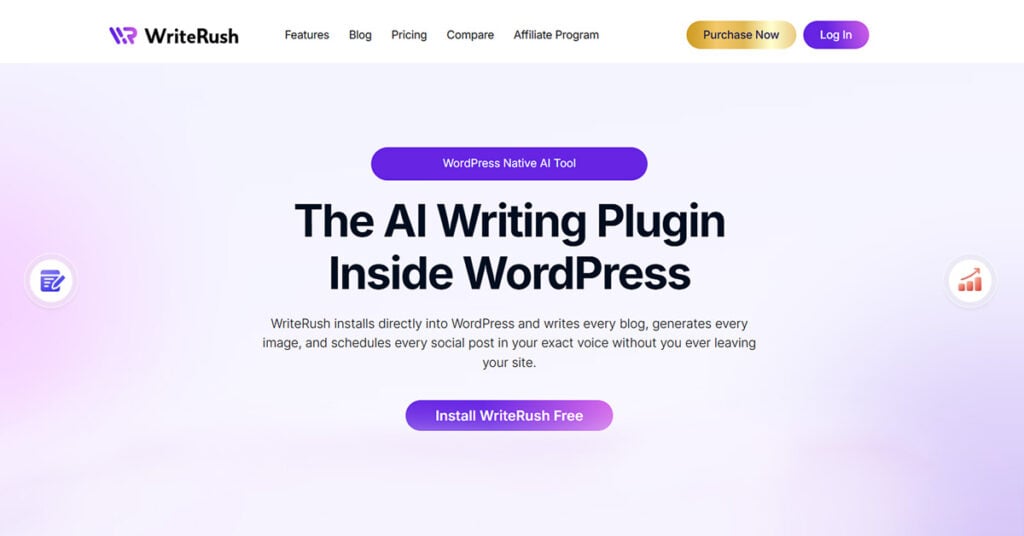
WriteRush is one of the best AI tools for content writing, especially for WordPress users, bloggers, agencies, and content marketers who want a complete writing workflow in one place. Instead of jumping between separate tools for keyword planning, outlining, drafting, image generation, and publishing, WriteRush brings the process together inside a guided AI-powered content system.
What makes WriteRush stand out is its focus on creating content that matches your brand voice. The platform is designed to analyze your writing style and adapt to your tone, helping you create content that feels more consistent and authentic. It also supports a faster workflow by helping users move from keyword or idea to a ready-to-publish WordPress draft with less manual work.
WriteRush is especially useful for users who create blog content regularly. It helps with SEO titles, outlines, drafts, images, keyword research, brand voice, and social media automation. For WordPress-focused creators, this makes it more than a basic AI writer; it works like a content marketing assistant built for the full publishing process.
Key Features of WriteRush
- AI-powered blog writing
- Guided content creation workflow
- SEO title and outline generation
- Brand voice support
- Keyword research assistance
- AI image generation
- WordPress draft publishing
- Social media automation
- One-click blog generation
- Content workflow simplification
Best For
WriteRush is best for bloggers, WordPress website owners, content marketers, SEO teams, and agencies that want to create optimized content faster without managing too many separate tools.
Why Choose WriteRush?
Choose WriteRush if you want an AI writing tool that does more than generate text. It helps you plan, write, optimize, and publish content from one workflow, making it a strong choice for users who want speed, SEO support, and brand consistency.
2. ChatGPT
ChatGPT is one of the most flexible AI tools for content writing. It can help with brainstorming ideas, writing blog sections, creating outlines, rewriting paragraphs, generating email copy, drafting social media posts, and improving readability.
The biggest strength of ChatGPT is versatility. You can use it for almost any type of writing task, from short-form captions to long-form guides. It is also useful for repurposing content, simplifying complex topics, and generating multiple versions of headlines or introductions.
However, ChatGPT works best when users provide clear prompts, brand guidelines, audience details, and editing instructions. Without proper guidance, the content may sound generic or need more human refinement.
Best For
ChatGPT is best for general content writing, brainstorming, rewriting, content planning, and flexible writing support across different formats.
3. Jasper
Jasper is a popular AI writing tool built mainly for marketing teams and businesses. It focuses on brand voice, campaign content, ad copy, landing pages, product descriptions, and long-form marketing content.
One of Jasper’s biggest advantages is that it is designed for teams that need consistent messaging across multiple channels. It can help marketers create content for blogs, emails, ads, social posts, and website pages while keeping the brand tone aligned.
Jasper is a strong option for businesses that need professional marketing copy at scale, but it may be more than what a solo blogger or small website owner needs.
Best For
Jasper is best for marketing teams, agencies, ecommerce brands, and businesses that need branded marketing content across different platforms.
4. Copy.ai
Copy.ai is another useful AI tool for content writing, especially for short-form marketing copy. It can help users create product descriptions, sales emails, social media captions, ad copy, website copy, and blog ideas.
Copy.ai is helpful for businesses that need quick content variations. For example, users can generate multiple versions of a headline, call-to-action, email subject line, or product description and then choose the best one.
It is particularly useful for sales and marketing workflows where speed and variation matter.
Best For
Copy.ai is best for short-form copywriting, sales content, product descriptions, social media posts, and quick marketing copy ideas.
5. Writesonic

Writesonic is an AI writing platform that supports blog writing, landing pages, ads, ecommerce descriptions, and SEO-focused content. It is useful for users who want a mix of long-form and short-form content generation.
The platform can help create article ideas, introductions, outlines, full blog drafts, and promotional copy. It is also suitable for users who want to speed up their content process without starting from a blank page.
Writesonic can be a good choice for bloggers, freelancers, and marketers who need quick drafts and content variations.
Best For
Writesonic is best for blog drafts, landing page copy, ad copy, ecommerce content, and fast content generation.
6. Grammarly
Grammarly is not a traditional AI content writing tool, but it is very useful for improving content quality. It helps users check grammar, spelling, clarity, sentence structure, tone, and readability.
For content writers, Grammarly works well as an editing assistant. After creating a draft with another AI writing tool, users can use Grammarly to polish the content and make it more professional.
It is especially helpful for teams that want cleaner, clearer, and more error-free writing.
Best For
Grammarly is best for editing, proofreading, grammar checking, tone improvement, and readability enhancement.
7. Surfer SEO
Surfer SEO is mainly an SEO content optimization tool. It helps writers create content that is better aligned with search engine expectations by analyzing keyword usage, headings, content length, related terms, and competitor pages.
Surfer SEO is useful when the main goal is ranking blog posts on Google. It can help writers understand what topics to cover, which terms to include, and how to structure content for better search performance.
It works best when combined with an AI writing tool. Writers can generate a draft first, then use Surfer SEO to optimize it.
Best For
Surfer SEO is best for SEO content optimization, content briefs, keyword usage, competitor analysis, and ranking-focused blog writing.
8. Frase
Frase is another strong AI tool for SEO content writing. It helps users research topics, analyze competitors, create content briefs, and write optimized articles.
Frase is especially useful for writers who want to understand search intent before creating content. It can help identify common questions, related topics, and important headings that should be included in a blog post.
This makes it valuable for SEO writers, content strategists, and agencies that create search-focused content regularly.
Best For
Frase is best for SEO research, content briefs, search intent analysis, and optimized blog writing.
9. Rytr
Rytr is a simple and affordable AI writing tool for users who need quick content assistance. It can help with blog ideas, emails, social media posts, product descriptions, and short copy.
Rytr is easy to use and works well for beginners who want basic AI writing support without a complex workflow. It may not offer the same depth as advanced SEO or brand-focused tools, but it is useful for simple writing tasks.
Best For
Rytr is best for beginners, freelancers, small businesses, and users who need affordable AI writing support.
10. Notion AI
Notion AI is useful for users who already organize their content, notes, and projects in Notion. It can help summarize notes, rewrite sections, brainstorm ideas, create drafts, and improve internal documentation.
For content teams, Notion AI can support planning and collaboration. It is especially helpful for turning rough notes into clearer content or organizing ideas into structured drafts.
Best For
Notion AI is best for content planning, note-based writing, team documentation, brainstorming, and productivity-focused writing workflows.
How to Choose the Best AI Tool for Content Writing
Choosing the best AI content writing tool depends on your goals, workflow, and content type. If you mainly publish WordPress blog posts and want an all-in-one content workflow, WriteRush is a strong choice. If you need flexible writing help for many tasks, ChatGPT can be useful. If your focus is marketing copy, Jasper or Copy.ai may be a better fit. For SEO-heavy content, tools like Surfer SEO and Frase can support optimization.
Before choosing a tool, consider these factors:
- What type of content do you create most often?
- Do you need SEO support?
- Do you publish directly on WordPress?
- Do you need brand voice consistency?
- Do you work alone or with a team?
- Do you need image generation or social media automation?
- Do you want a simple writer or a complete content workflow?
The best AI writing tool should not only help you write faster. It should also help you create useful, accurate, optimized, and brand-consistent content.
Benefits of Using AI Tools for Content Writing
AI tools can make content writing faster, easier, and more scalable. They help remove the blank-page problem and give writers a clear starting point. Instead of spending hours planning a topic from scratch, users can generate ideas, outlines, and first drafts within minutes.
Another major benefit is consistency. AI tools can follow a specific tone, structure, and writing style, which is useful for businesses that publish content across blogs, websites, emails, and social media.
AI tools also support SEO by helping writers include relevant keywords, organize headings, answer common questions, and improve readability. This makes content more useful for readers and easier for search engines to understand.
AI Writing Tools vs. Human Writers
AI writing tools are powerful, but they should not completely replace human writers. AI is excellent for speed, structure, brainstorming, rewriting, and first drafts. Human writers are better at storytelling, original insights, emotional connection, brand strategy, fact-checking, and final quality control.
The best approach is to combine both. Use AI tools to speed up the writing process, then use human editing to improve accuracy, personality, flow, and trustworthiness.
This hybrid workflow helps businesses publish more content without sacrificing quality.
Streamlining Content Creation with WriteRush
WriteRush is an AI-powered writing solution designed especially for WordPress, helping you move from idea to publish-ready post in fewer steps.
Key Features in Your Workflow
- In-Editor AI Writing Assistant: You can create, revise, and optimize long-form content directly within WordPress—no copy-pasting needed.
- SEO & Originality Tools: Keyword suggestions, readability scoring, and plagiarism checks are part of the WriteRush workflow, so every draft hits quality and ranking benchmarks.
- Workflow Automation: Schedule posts, assign drafts to team members for review, and manage approvals all inside your usual dashboard.
- Brand Voice Adaptation: Edit and refine AI output with ‘humanize’ features that make sure each post sounds like you—not a robot.
For content teams, WriteRush eliminates the most common publishing slowdowns. For solo bloggers, it’s like having a co-writer and editor at your fingertips—letting you focus on topics that matter most to your audience.
Common Pitfalls When Using AI Content Writing Tools
AI tools are powerful, but they require the right approach to avoid common mistakes.
- Over-reliance on AI Output: Publishing without editing leads to generic or unoriginal content. Human review is essential.
- Neglecting Originality Checks: Skipping plagiarism detection can create legal and SEO headaches.
- Forgetting SEO Details: Failing to optimize for structure, keywords, or metadata leaves content invisible to search engines.
- Skipping Platform Integration: Using incompatible tools disrupts your publishing workflow, especially on WordPress.
- Poor Multi-User Management: Without clear editing rights and approvals, team content can become inconsistent or error-prone.
A better approach is to treat AI output as a draft, always reviewing, refining, and optimizing before publishing. In complex workflows, clear roles and checklists protect your brand and streamline delivery.
Final Thoughts
AI tools for content writing are changing how bloggers, marketers, and businesses create content. They can help with planning, drafting, editing, SEO, brand voice, and publishing. But the best tool depends on your workflow and content goals.
For WordPress users and content marketers who want a complete writing and publishing workflow, WriteRush is a top choice. It helps simplify the entire process from idea to publish-ready content, making it easier to create high-quality blog posts faster.
Whether you are a solo blogger, agency, or business owner, the right AI content writing tool can save time, reduce content stress, and help you publish more consistently.
Frequently Asked Questions
What is an AI writing tool and how does it work?
An AI writing tool uses machine learning and natural language processing to help generate or improve written content. You provide a prompt or outline, and the tool produces drafts, suggestions, or entire articles in response.
Are there any free AI tools for content writing?
Yes, several AI writing tools offer free versions, though these usually have limited features or word count caps. For higher volume or advanced SEO support, paid plans may be necessary.
Can AI writing software help with SEO?
Most modern AI content tools include SEO features such as keyword suggestions, structure optimization, and readability checks. This helps your content rank higher by meeting both audience and search engine expectations.
Can I use AI writing tools within WordPress?
Yes, some tools—like WriteRush—offer direct WordPress integration, letting you create, edit, and publish drafts without switching between platforms. This saves time and ensures workflow consistency.
How can I make AI-generated content sound more like my brand?
Use the tool’s editing and “humanize” features to adapt tone and style. Clear prompts and detailed brand voice guidelines also help AI output match your personal or organizational voice.
This page was last edited on 24 June 2026, at 4:48 pm