
Quick Answer
The best AI for writing depends on your needs, but as of June 2026, leading options include OpenAI’s GPT-4o, Anthropic’s Claude 3.7, and Sudowrite’s Muse model. Each excels in specific areas such as SEO blogging, fiction, and business content.
If you’ve tried to research the “best AI for writing,” you’ve probably felt more confused the longer you looked. Pages full of tool lists, conflicting reviews, and buzzwords make it feel impossible to land on the right choice. Whether you’re a blogger tired of juggling drafts, a content manager facing tight deadlines, or a business owner trying to scale without burning out your team, the real struggle is matching a tool to your actual workflow.
Most people don’t just want fancy new software—they want reliable results, time saved, and a smoother process from idea to publish. That’s why we’ve created this guide: to cut through vendor noise and marketing hype. By the end, you’ll know exactly what matters when choosing an AI writer, how today’s top models compare, and the hidden details that make the difference—especially if you rely on WordPress, SEO, or creative content.
What Is the Best AI for Writing?
The best AI for writing is an advanced tool that leverages large language models—like GPT-4o, Claude 3.7, or Sudowrite Muse—to generate, edit, or optimize human-like text across a range of formats. These AIs are built to understand context, follow style cues, and support different writing needs, from website copy to novels.
In simple terms, an effective AI writing tool balances high-quality output, workflow compatibility, brand voice control, and integration with platforms like WordPress or Google Docs. The ideal AI fits not just your type of content but how you create it—whether you’re a solo blogger, content marketer, or business team managing multiple projects.
Best AI for Writing: Top Tools Based on Your Content Goals
The best AI for writing depends entirely on what you want to create. Some tools are better for brainstorming and quick drafting, while others are stronger for long-form writing, marketing copy, editing, or creative storytelling. If your main goal is to create SEO-focused blog content for WordPress, a complete writing workflow matters more than simple text generation.
Below is a breakdown of the best AI writing tools categorized by their biggest strengths.
1. WriteRush — Best for SEO Blog Writing and WordPress Content Creation
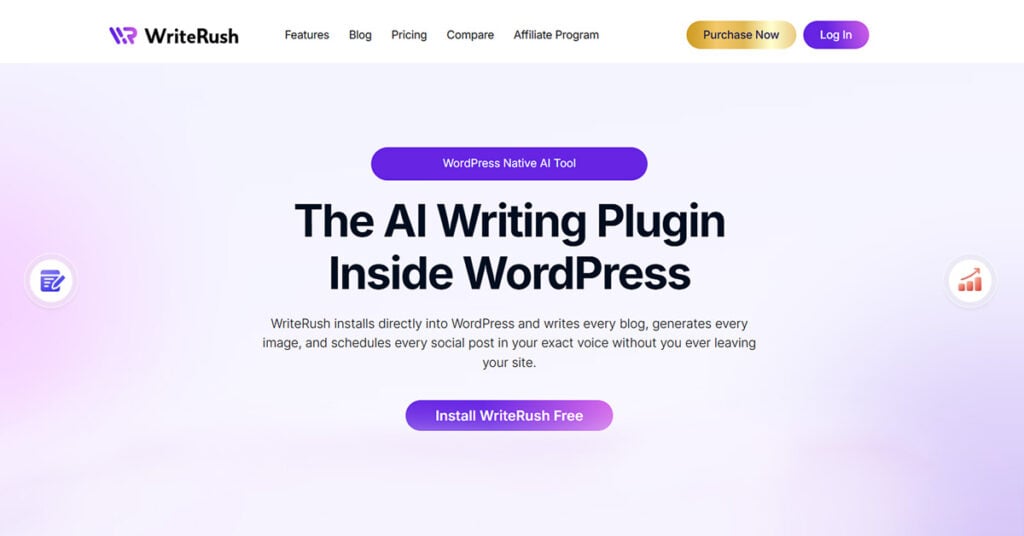
WriteRush is the best AI writing tool for bloggers, marketers, agencies, freelancers, and WordPress website owners who want to create SEO-focused content faster. Unlike general AI writing tools that only generate text, WriteRush is built around the full content creation workflow.
It helps users research keywords, generate SEO-friendly blog titles, create structured outlines, write long-form blog posts, train AI with brand voice, generate AI images, create social media content, and send publish-ready content directly to WordPress drafts. This makes it a powerful choice for anyone who wants to reduce tool switching and manage content creation from one place.
WriteRush is especially useful for users who publish blog content regularly. Instead of using separate platforms for keyword research, AI writing, SEO planning, image generation, and WordPress publishing, users can handle the major steps inside one guided workflow.
Best for: WordPress users, bloggers, SEO writers, content agencies, marketers, affiliate site owners, and business owners.
Why choose WriteRush: It combines SEO planning, AI blog writing, brand voice, image generation, and WordPress publishing support in one platform.
2. ChatGPT — Best for General Drafting and Brainstorming
ChatGPT is one of the most versatile AI writing tools available. It works like a flexible writing assistant that can help with outlines, blog ideas, short-form content, emails, summaries, rewrites, FAQs, product descriptions, and general brainstorming.
It is a strong choice when you need fast ideas or a quick first draft. Writers, students, marketers, and professionals can use ChatGPT to explore angles, simplify complex topics, improve structure, or generate different versions of the same message.
However, ChatGPT is more of a general-purpose writing assistant than a complete SEO publishing workflow. For users who need keyword research, SEO blog planning, and WordPress draft publishing in one place, WriteRush offers a more focused solution.
Best for: Brainstorming, outlining, quick drafts, rewriting, idea generation, and general writing support.
Why choose ChatGPT: It is flexible, easy to use, and useful for many different writing tasks.
3. Google Gemini — Best for Google Workspace Users
Google Gemini is a strong option for users who already work heavily inside Google Workspace. It can help with quick writing tasks inside tools like Google Docs and Gmail, making it useful for emails, document edits, summaries, and everyday productivity writing.
For people who spend most of their time in Google’s ecosystem, Gemini can make writing and editing more convenient. It is especially useful for polishing documents, drafting email replies, summarizing information, and improving productivity across Google apps.
Best for: Google Docs users, Gmail users, students, professionals, and teams using Google Workspace.
Why choose Gemini: It fits naturally into Google’s productivity tools and helps with quick writing and editing tasks.
4. Claude — Best for Natural Long-Form Writing
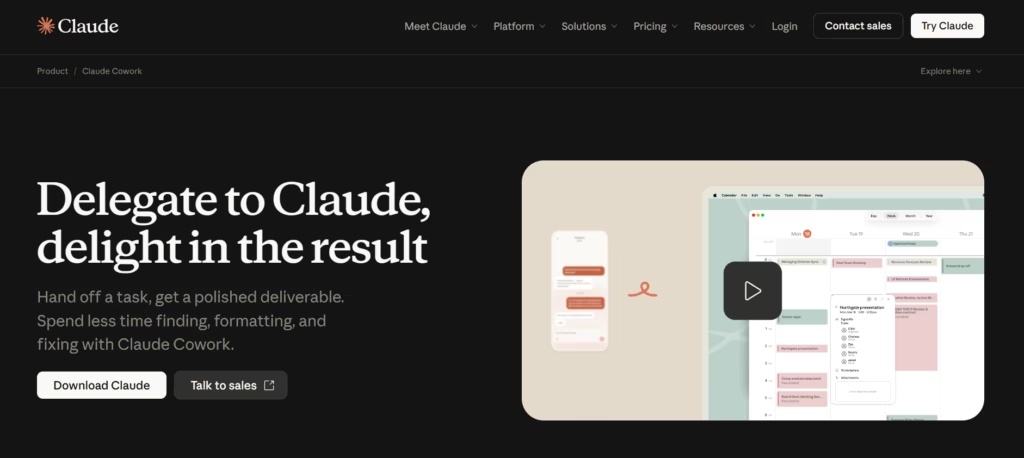
Claude is widely preferred for natural-sounding long-form writing. It is known for producing thoughtful, human-like prose with smooth flow and less robotic wording. This makes it useful for essays, reports, newsletters, research-based content, and detailed explanations.
Claude is also strong at handling longer context, which helps when working with complex topics or large documents. Writers who care about tone, nuance, and readability may find Claude helpful for creating polished long-form drafts.
Best for: Essays, newsletters, research content, reports, thoughtful explanations, and long-form writing.
Why choose Claude: It is strong at creating natural, well-structured writing with a more human-like tone.
5. Jasper AI — Best for Business and Marketing Copy
Jasper AI is built for marketing teams that need consistent, brand-focused content. It is especially useful for businesses creating blog posts, landing page copy, ad copy, campaign content, social media posts, and product messaging.
One of Jasper’s biggest strengths is brand voice consistency. Marketing teams can use it to keep messaging aligned across different channels. This makes it a good option for companies that need professional copy at scale.
Best for: Marketing teams, agencies, brand managers, and businesses creating campaign content.
Why choose Jasper: It is strong for brand-focused marketing copy and multi-channel content creation.
6. Copy.ai — Best for Sales and Marketing Workflows
Copy.ai is useful for sales and marketing professionals who want to speed up campaign content, outreach messages, social posts, and promotional copy. It helps users generate different versions of marketing content and refine messaging for specific audiences.
It is a good choice for teams that want a tool focused on go-to-market content rather than only blog writing. Copy.ai can support workflows for ads, emails, lead generation, and sales communication.
Best for: Sales teams, marketers, social media managers, and campaign teams.
Why choose Copy.ai: It helps speed up marketing and sales content creation with repeatable AI workflows.
7. Sudowrite — Best for Fiction and Creative Writing
Sudowrite is designed specifically for fiction writers, novelists, and screenwriters. Unlike many AI writing tools that focus on business or marketing content, Sudowrite is built to support storytelling, character development, scene expansion, and creative brainstorming.
It can help writers overcome writer’s block, explore new plot directions, rewrite scenes, and develop more descriptive prose. For creative writers, it works more like a brainstorming partner than a standard AI copy generator.
Best for: Novelists, screenwriters, fiction writers, and creative storytellers.
Why choose Sudowrite: It is built for creative writing and helps with story ideas, scenes, characters, and fictional prose.
8. Grammarly — Best for Editing and Refining Content
Grammarly is one of the best AI tools for improving writing quality. It focuses on grammar, spelling, clarity, tone, conciseness, and readability. Instead of generating full content from scratch, Grammarly helps improve the content you already have.
It is useful for emails, blog drafts, documents, reports, academic writing, and business communication. Writers can use it to polish their work, remove errors, and make their writing clearer and more professional.
Best for: Proofreading, editing, grammar correction, tone improvement, and clarity.
Why choose Grammarly: It helps refine your writing and make it more polished across different platforms.
Which AI Writing Tool Is Best for You?
The right AI writing tool depends on your main writing goal. If you need general brainstorming, ChatGPT is a strong choice. If you want natural long-form writing, Claude is a great option. For marketing teams, Jasper and Copy.ai are useful. For fiction, Sudowrite is built specifically for storytelling. For editing, Grammarly remains one of the strongest tools.
But if your goal is to create SEO blog content for WordPress, WriteRush is the best choice. It gives you a complete workflow for keyword research, content planning, AI writing, brand voice, image generation, social content, and WordPress draft publishing. For bloggers, agencies, marketers, and website owners who want to publish better content faster, WriteRush offers a more practical and focused AI writing solution.
How to Choose the Best AI for Your Specific Needs
Choosing the best AI for writing starts with understanding your priorities:
- Quality output: Does the AI produce natural, undetectable writing?
- Creativity and tone: Can it adapt to your brand or story style?
- Budget: What’s the price, and are there worthwhile free options?
- Workflow integration: Does it work with your current tools (like WordPress)?
- Customization and templates: How easily can you adjust prompts and outputs?
- Team features: Is collaboration, commenting, or versioning built-in?
Matching Tools to Use Cases
Here’s how today’s top AI writing tools fit different needs:
- Blogging & SEO Content: Look for tools like GPT-4o or Claude 3.7, or platforms with built-in SEO brief generation and easy WordPress publishing.
- Fiction & Creative Writing: Sudowrite’s Muse model shines at dialogue, scene-building, and unique voice.
- Business/Marketing Teams: Prioritize robust team permissions, brand style memory, and batch content processing. Jasper AI and Copy.ai offer these.
- Editing/Proofreading: Grammarly, ProWritingAid, and AI tools with strong rewriting and tone adjustment features make polishing easy.
A better approach is thinking about your “daily pain points.” If you frequently lose track of revisions or spend hours uploading drafts, prioritize integration and collaboration. For those focused on storytelling, flexibility and creative prompts matter more.
Real-World Workflow: Integrating AI Writing Tools (WriteRush in Focus)
The real power of an AI writing tool shows when it fits naturally into your working environment—especially if you publish through WordPress. Platforms like WriteRush are engineered for this. Instead of working in isolated apps and copying content over, you can draft, edit, optimize for SEO, and publish straight from your WordPress dashboard.
- Choose from prompt templates tailored for blogging, product reviews, or long-form content,
- Auto-generate SEO-friendly headlines and structures,
- Maintain consistent brand voice with reusable style cues,
- Push polished drafts live with a single click.
For busy bloggers or teams, this means fewer handoffs, cleaner processes, and content that’s always ready to rank. WriteRush’s workflow is a good example because it quietly handles technical steps—so you can stay focused on quality and growth.
Common Pitfalls When Using AI for Writing
Even the best AI writing tools don’t guarantee great results if you fall into common traps:
- Using only default prompts leads to generic, flat content.
- Neglecting to set brand voice parameters makes your output less authentic.
- Failing to check for AI detection risks can hurt your SEO or trustworthiness.
- Manually moving drafts between tools and WordPress increases error rates and wastes time.
- Chasing hype over fit—new doesn’t always mean better for your needs.
In our experience, the key is not just picking the right tool, but setting it up to reflect your workflow, brand, and publishing habits. Avoid shortcuts, and always review generated text for both quality and originality.
Conclusion
Choosing the best AI for writing is less about chasing the latest tools and more about fit—matching the tool’s strengths to your real workflow and goals. Whether you need sharper SEO, easier WordPress publishing, or support for creative projects, today’s top AI models have you covered.
For WordPress bloggers and content teams seeking both power and seamless experience, solutions like WriteRush make advanced AI writing accessible and practical—right where the work happens. Ready to transform your publishing process? Explore AI writing tools that actually fit your needs, and see how integration can become your top productivity hack.
FAQs
What is the best AI writing tool for SEO and blogging?
ChatGPT (GPT-4o) and Claude 3.7 are leading options for blogging and SEO content, with support for focused prompts, optimization features, and integrations with writing platforms.
Which AI writer produces the most human-like prose?
Claude 3.7 is currently regarded for its human-like tone and nuanced style, especially for web content and longer-form writing.
Can AI writing tools be integrated directly with WordPress?
Yes, many AI tools now offer direct WordPress integration or plugins. WriteRush, for example, enables drafting, editing, and publishing inside the WordPress dashboard.
How do AI writers perform against detection tools?
Performance varies by model, prompt, and output length. Newer AIs like GPT-4o and Claude 3.7, when fine-tuned, can produce highly undetectable content, but it’s still wise to humanize and review all outputs.
What features should businesses or content teams look for?
Key features include collaboration controls, brand voice templates, workflow automation, batch publishing, and version tracking for team transparency.
Are there effective free AI writing tools for beginners?
Some platforms offer limited free plans (like ChatGPT and Claude), but robust features, integrations, and advanced models are usually found in paid tiers.
How can I make sure my AI-generated content matches my brand’s style?
Use AI tools with “style memory” or brand voice features, create prompt templates, and always review or lightly edit for tone and consistency before publishing.
Which AI is most suitable for fiction and creative writing?
Sudowrite’s Muse model focuses on creativity, scene-building, and dialogue, making it a favorite among fiction authors.
What are the risks of using AI for large-scale publishing?
Risks include loss of authenticity, detection issues, content repetition, and errors from poor workflow integration. A balance of automation and human oversight is critical.
How can I optimize AI prompts for better writing output?
Use detailed, context-rich prompts, tailor them to your brand and goals, and refine based on the content type. Tools with prompt libraries, like WriteRush, help streamline this process.
This page was last edited on 23 June 2026, at 5:00 pm