
A few months ago, a blogger friend messaged me in panic:
“I’ve been using AI to speed up my blog posts. Now I’m scared, can Google detect AI-generated content and penalize my site?”
If you’re a blogger, content marketer, or WordPress user, chances are you’ve asked the same question, maybe silently, maybe at 2 a.m. while refreshing Search Console.
AI tools are everywhere now. They help us brainstorm faster, write drafts in minutes, and scale content without burning out. But with Google updates, spam policy talks, and scary headlines, one fear keeps coming back:
“Will Google punish my site if I use AI?”
Let’s clear the confusion, without myths, fear-mongering, or technical jargon.
The Short Answer (TL;DR)
Yes, Google can detect patterns commonly linked to AI-generated or automated content, especially when it is low-value, repetitive, or published at scale.
Google’s primary focus is on content quality and helpfulness, not the content’s origin.
- Google doesn’t automatically penalize AI-generated content
- Google cares about content quality, usefulness, and originality, not who (or what) wrote it
- The real risk is publishing low-value, mass-produced AI content just to rank
- AI-assisted content can rank very well when it’s helpful, edited, and written for humans
So, AI is not the enemy. Low-quality content is!
However, Google does not automatically penalize content just because AI was used. Google mainly evaluates whether the content is helpful, original, accurate, and created for people.
Does Google Penalize AI-Generated Content?
Google does not penalize content just because it was created with AI. The main issue is not whether you used ChatGPT, Gemini, Claude, or another AI writing tool. The issue is whether the final content is helpful, original, accurate, and created for people instead of search engines.
AI-generated content can become risky when it is published without human review, repeats what already exists online, includes inaccurate claims, or is produced at scale only to manipulate rankings. Google’s spam policies focus on low-value and manipulative content, regardless of whether it was written by humans, AI, or both.
To build a safer long-term strategy, you should focus on helpful AI content marketing instead of publishing AI-generated content only for search rankings.
What Google Officially Says About AI-Generated Content
Let’s clear up the biggest myth first.
When people ask, “Can Google detect AI-generated content?”, what they’re often really asking is:
“Does Google hate AI content?”
The short answer? No, Google doesn’t ban AI content.
However, there’s an important point that you need to understand.
Google Doesn’t Penalize Content Just for Being AI-Written
Google has publicly stated that AI-generated content is not against its guidelines, as long as it’s created to help users, not to manipulate search rankings.
In other words, Google doesn’t judge content by who (or what) wrote it. Instead, it evaluates:
- Usefulness
- Originality
- Accuracy
- Relevance to search intent
This aligns directly with Google Search Essentials and the Helpful Content System, which are designed to reward people-first content, regardless of whether it’s written by humans, AI tools, or a combination of both.
So yes, AI-assisted content can rank on Google when it genuinely adds value.
When AI Content Becomes a Problem for Google
Now here’s where many sites get into trouble.
Google does take action against content that is:
- Mass-produced using automation
- Thin, repetitive, or unoriginal
- Created primarily to game search rankings
This falls under what Google calls scaled content abuse, and it applies to both AI-written and human-written content.
For example:
- Publishing dozens of near-identical blog posts with swapped keywords
- Generating pages without editorial review
- Rewriting existing articles without adding any new insight
In these cases, Google isn’t penalizing AI; it’s penalizing low-quality content.
More: How to Humanize AI-Generated Content
How Google “Detects” Low-Quality AI Content (Indirectly)
While Google doesn’t rely on a single AI content detector, it uses advanced machine learning systems to identify patterns that often appear in poor-quality automation, such as:
- Repetitive sentence structures and phrasing
- Lack of depth or original analysis
- Missing experience or expert perspective
- Obvious keyword stuffing or unnatural language
If content shows these signals, especially at scale, it may struggle to rank, regardless of whether it was written by a human or an AI tool.
If your AI drafts sound robotic or repetitive, improving your prompts can help you create more natural, human-like content from the beginning.
What Google Actually Rewards (AI or Not)
To stay on the safe side, focus on what Google consistently rewards:
- Helpful, intent-matched content
- Clear structure and readability
- Original examples, insights, or experiences
- Trust signals like accurate information and credible sources
Google doesn’t ask, “Was this written by AI?”
Google asks,
- Does the content solve the user’s problem?
- Is it original, or just reworded from other pages?
- Does it demonstrate experience, expertise, and trust (E-E-A-T)?
- Is the content readable, structured, and easy to understand?
If your content performs well in these areas, it can rank, regardless of whether AI was involved.
What Is Scaled Content Abuse?
Scaled content abuse happens when a website publishes many pages mainly to manipulate search rankings instead of helping users. This can include AI-generated pages, human-written pages, or mixed content. The problem is not only automation. The problem is publishing large amounts of unoriginal, thin, or low-value content.
For example, a website may be at risk if it uses AI to create hundreds of similar blog posts without real examples, expert review, original insights, or useful information. Google’s policy specifically says scaled content abuse can happen no matter how the content is created.
Safe AI Content vs Risky AI Content
Safe AI content is not about hiding AI use. It is about making sure the final content is useful, accurate, original, and reviewed by a human before publishing. Risky AI content, on the other hand, usually lacks real value, repeats existing information, or is created mainly to manipulate search rankings.
The table below shows the key differences so you can use AI writing tools without hurting your SEO performance.
| Safe AI-Assisted Content | Risky AI-Generated Content |
|---|---|
| Reviewed and edited by a human | Published directly from AI |
| Includes original examples or experience | Repeats common information |
| Fact-checked before publishing | Contains unsupported claims |
| Matches search intent clearly | Written only to rank for keywords |
| Adds expert insight or brand opinion | Sounds generic and robotic |
| Updated regularly | Left outdated after publishing |
| Helps the reader solve a problem | Exists mainly for SEO traffic |
Many ranking issues happen because of common AI writing mistakes, such as publishing unedited drafts, using vague claims, or skipping fact-checking.
Why AI Detection Tools Can Be Misleading?
At some point, almost every blogger or content marketer does this:
You paste your article into an AI detection tool, see a scary percentage, and immediately panic. But here’s the reality you need to hear:
AI detection tools are not Google, and Google doesn’t rely on them to rank content.
So if you’re worried about “Can Google detect AI-generated content?”, focusing on detector scores is the wrong battle.
Most third-party AI content detectors work by guessing patterns in text. However, these tools come with major limitations:
- They often flag human-written content as AI-generated
- AI-assisted content that’s been edited can pass as “human.”
- Results vary widely from one detector to another
- They don’t measure helpfulness, search intent, or content quality
In fact, even AI companies have acknowledged that reliably detecting AI-written text is extremely difficult, especially once the content has been edited.
Can AI Content Rank on Google? Yes, and Here’s Why
By now, you might be wondering:
If Google can detect AI-generated content, does that mean AI content can’t rank?
The answer is reassuring: YES, AI-assisted content can rank on Google, and many pages already do.
Let’s look at why this works and what actually makes the difference.
AI Content Isn’t Automatically a Ranking Disadvantage
Google doesn’t use “AI-written” as a negative ranking signal. In fact, multiple industry studies have found no direct correlation between AI-generated content and lower rankings.
What Google evaluates instead is:
- Search intent alignment
- Content quality and depth
- Originality and usefulness
- User-focused structure and readability
So, whether content is written by a human, AI, or a mix of both, it can rank if it meets these criteria.
Why Some AI Content Ranks (and Others Don’t)
Here’s the key distinction many people miss.
AI content that ranks well usually:
- Is based on SERP analysis, not guesswork
- Covers topics comprehensively, not superficially
- Includes original insights, examples, or experiences
- Has been edited and refined by a human
On the other hand, AI content that struggles often:
- Repeats what’s already ranking
- Feels generic or padded
- Lacks credibility or depth
- Is published at scale without quality control
Google isn’t “detecting AI”, it’s detecting value (or the lack of it).
Search Intent Still Beats “AI vs Human”
One of the biggest reasons AI-assisted content ranks is simple:
It can be very good at matching search intent when used correctly.
For example:
- Informational queries need clarity and completeness
- How-to searches need steps and examples
- Comparison queries need real pros, cons, and recommendations
When AI helps you structure content around these needs, and you add the final human touch, Google sees a page that genuinely serves the user.
When you treat AI as a writing partner, not a shortcut, ranking becomes a lot more achievable.
How to Use AI Content Safely for SEO
The good news is that using AI safely isn’t complicated. It simply requires a clear workflow that prioritizes quality, originality, and user intent, not shortcuts. An AI blog writer can help you create faster first drafts, but the final content should still include human review, real examples, and SEO intent alignment.
Let’s walk through a practical, Google-friendly approach.
Step 1: Start with Search Intent (Before AI Writes a Single Word)
Before generating any content, take a moment to understand why someone is searching.
Ask yourself:
- Are they looking for information, steps, comparisons, or advice?
- What questions do top-ranking pages already answer?
- What’s missing or under-explained?
Matching search intent early helps prevent thin content, one of the biggest reasons AI-generated pages fail.
Step 2: Build a SERP-Based Outline (Your Safety Net)
Instead of guessing topics, create an outline based on what’s already ranking.
A strong SERP-based outline ensures:
- All essential subtopics are covered
- Content aligns with Google’s expectations
- Your article feels complete and authoritative
This is especially helpful for WordPress users managing multiple posts or client sites, where consistency matters.
Step 3: Use AI to Draft, Not to Finish
AI works best as a drafting assistant, not an autopilot.
Use AI to:
- Expand outline sections
- Explain concepts clearly
- Speed up first drafts
But remember: raw AI output is rarely publish-ready. Think of it as clay; you still shape the final piece.
Step 4: Add Original Value AI Can’t Fake
This is where your content becomes “Google-safe.”
Upgrade AI drafts with:
- Real examples or use cases
- Personal experience or lessons learned
- Screenshots, workflows, or step-by-step explanations
- Unique opinions backed by reasoning
These experience signals help your content stand out from mass-produced AI articles.
Step 5: Edit for Brand Voice and Natural Flow
AI content often sounds:
- Neutral
- Over-explained
- Slightly repetitive
Editing fixes that.
Take time to:
- Simplify sentences
- Add transitions and conversational phrases
- Maintain a consistent brand voice
- Improve readability for real users
For WordPress sites, this step is crucial for long-term trust and engagement.
Step 6: Fact-Check and Strengthen Trust Signals
To align with Google’s quality guidelines:
- Verify statistics and claims
- Update outdated information
- Add sources where relevant
- Avoid vague or speculative statements
Accuracy builds trust with both readers and search engines.
Step 7: Optimize and Publish Inside WordPress
Before publishing:
- Refine headings (H2s and H3s)
- Add internal links to related posts
- Write a compelling meta title and description
- Include FAQs or a summary section for completeness
This final polish ensures your AI-assisted content is helpful, structured, and SEO-ready.
To build a safer long-term strategy, you can also read our guide on AI content marketing and learn how to use AI without publishing low-value content.
If you publish content on WordPress, using the right AI writing plugins can help improve your drafting, editing, and optimization workflow.
Are AI Content Detectors Accurate?
AI content detectors can sometimes identify patterns that look machine-generated, but they are not always accurate. A detector score should not be treated as final proof that content is bad, spammy, or written by AI. Even human-written content can sometimes be flagged as AI-written.
For SEO, the better approach is not to obsess over AI detector scores. Instead, review the content for usefulness, originality, accuracy, clarity, and real human input. Google’s own guidance focuses more on helpfulness and value than the content creation method itself.
Instead of only depending on AI detector scores, focus on improving readability, originality, and clarity with a proper AI content humanizing process.
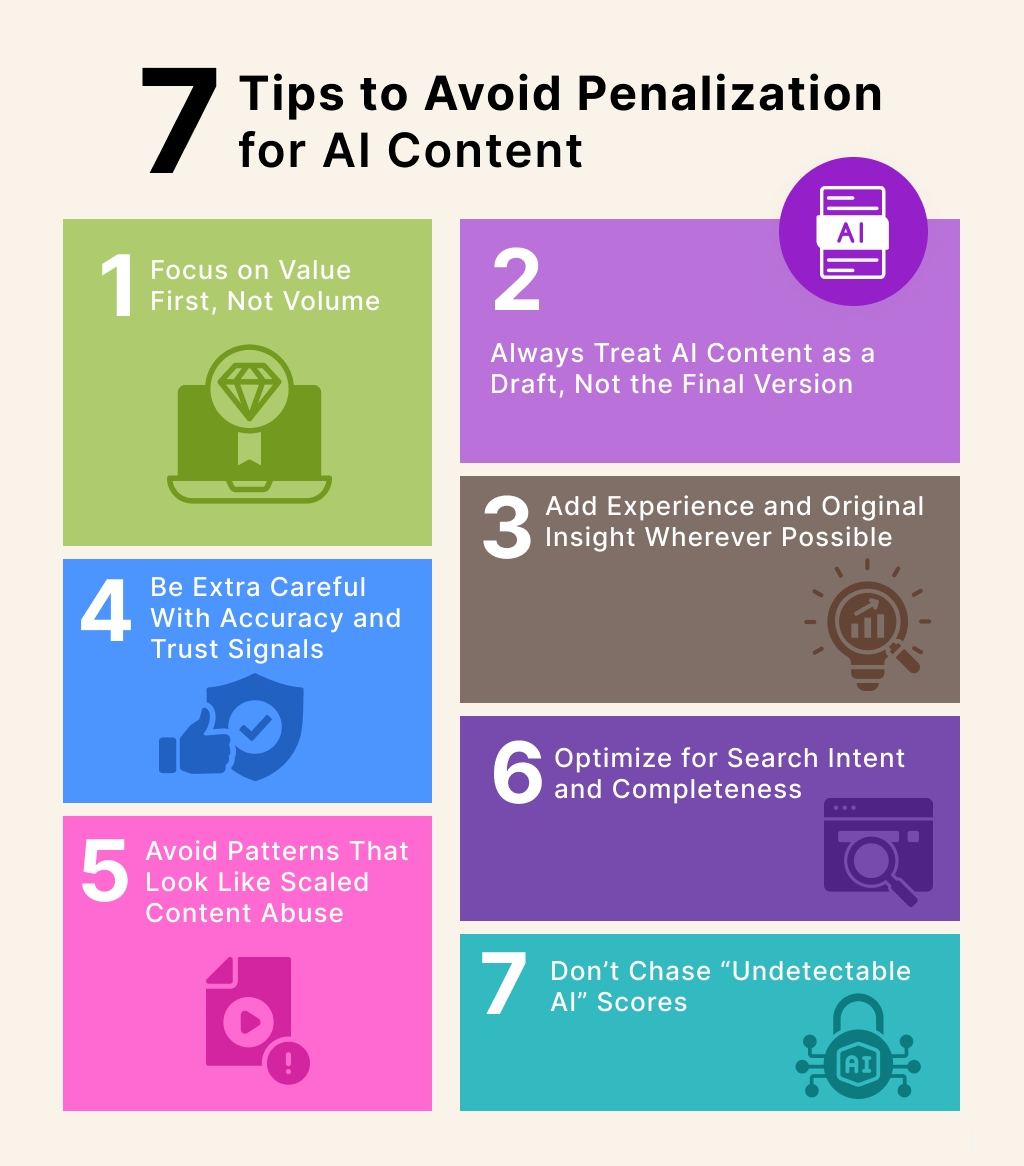
Tips to Avoid Penalization When Using AI Content
By now, it should be clear that the real question is “how to use AI without sending low-quality signals to Google.”
The good news? Avoiding penalties is less about hiding AI and more about publishing responsibly. Here are some practical, Google-safe tips you can follow with confidence.
1. Focus on Value First, Not Volume
First and foremost, resist the urge to publish at scale just because AI makes it easy.
Google is quick to downgrade content that feels:
- Mass-produced
- Repetitive
- Created primarily to rank rather than help
Instead, aim for fewer, higher-quality posts that genuinely solve a problem or answer a question in depth. One well-crafted article will always outperform ten thin ones.
2. Always Treat AI Content as a Draft, Not the Final Version
AI is great at speeding things up, but it shouldn’t replace editorial judgment.
Before publishing:
- Rewrite generic or overly polished sentences
- Remove filler and redundant explanations
- Improve flow and readability
- Align the content with your brand voice
A simple human edit can be the difference between content that ranks and content that gets ignored.
3. Add Experience and Original Insight Wherever Possible
One of the easiest ways to make AI-assisted content safer (and stronger) is by adding things AI can’t replicate.
For example:
- Real-life use cases or client examples
- Personal lessons learned or mistakes to avoid
- Screenshots, workflows, or step-by-step processes
- Unique frameworks or checklists
These experience signals help Google and readers see your content as original and trustworthy.
4. Be Extra Careful With Accuracy and Trust Signals
Google places a strong emphasis on accuracy and reliability, especially for informational content.
So, make it a habit to:
- Fact-check statistics and claims
- Update outdated information
- Avoid vague or speculative statements
- Add sources where appropriate
This not only improves credibility but also aligns with Google’s E-E-A-T principles.
5. Avoid Patterns That Look Like Scaled Content Abuse
Even well-written AI content can run into trouble if it follows obvious automation patterns.
Watch out for:
- Multiple pages with the same structure and wording
- Keyword-swapped posts targeting similar queries
- Publishing dozens of near-identical articles in a short time
Consistency is good, but duplication at scale is risky.
6. Optimize for Search Intent and Completeness
Instead of worrying about detection tools, focus on whether your content fully satisfies the user’s intent.
Ask yourself:
- Does this page answer all relevant questions?
- Is it more helpful than what’s currently ranking?
- Does it guide the reader toward a clear takeaway or next step?
When content feels complete and useful, Google has no reason to treat it as low-quality.
7. Don’t Chase “Undetectable AI” Scores
Finally, one important reminder: AI detection tools are not ranking factors.
Trying to make content “undetectable” often leads to:
- Over-editing
- Awkward phrasing
- Writing for tools instead of people
If your content reads naturally, provides real value, and serves the user well, you’re already doing what Google wants.
Does AI Content Affect Visibility in AI Overviews?
AI-generated content can still appear in Google Search and AI-powered search experiences if it is useful, trustworthy, and clearly answers the user’s question. However, content created only to manipulate traditional search rankings or AI-generated answers can be treated as spam.
In 2026, Google also updated its spam rules to include attempts to manipulate AI-powered search experiences, such as AI Overviews and AI Mode. This makes it even more important to create genuinely helpful content instead of trying to game AI search systems.
To improve AI search visibility, add:
- Clear definitions
- Short direct answers
- FAQ-style sections
- Original examples
- Author expertise
- Updated facts
- Schema markup
- Concise summaries under major headings
Closing Thoughts
So, after breaking it all down, let’s come back to the big question: Can Google detect AI-generated content?
YES!
But more importantly, Google doesn’t judge content by whether it’s written by AI or humans. It judges content by quality, originality, and helpfulness.
In fact, Google’s ranking systems are designed to reward people-first content that matches search intent, demonstrates trust, and delivers real value. That means AI-assisted content can absolutely rank when it’s edited, accurate, and created with purpose.
On the other hand, mass-produced, low-value content, whether written by AI or humans, will always struggle. That’s where most of the fear around AI content penalties comes from.
The smart approach isn’t to hide AI usage or chase detection tools. Instead, focus on adding experience, refining brand voice, and publishing responsibly, especially on WordPress.
FAQs
1. Can Google detect AI-generated content?
Yes, Google can identify patterns commonly found in AI-generated or automated content, especially when it’s mass-produced or lacks originality. However, Google does not penalize content simply for being written by AI; it evaluates quality, usefulness, and relevance instead.
2. Does Google penalize AI-generated content?
No, Google does not automatically penalize AI-generated content. Penalties occur when content is spammy, low-quality, or created primarily to manipulate search rankings, regardless of whether it’s written by AI or humans.
3. Can AI-generated content rank on Google?
Yes, AI-assisted content can rank well on Google if it’s helpful, accurate, original, and aligned with search intent. Many ranking pages today use AI as part of their content creation process.
4. Does Google use AI detection tools to identify AI content?
No, Google does not rely on third-party AI detection tools. Instead, it uses advanced machine learning systems to evaluate content quality signals like originality, depth, and user satisfaction.
5. Is AI-generated content considered plagiarism?
Not necessarily. AI-generated content is only considered plagiarism if it copies or closely paraphrases existing content without adding value. Proper editing and originality help avoid plagiarism issues.
6. Should I disclose that my content is AI-generated?
Google does not require disclosure. However, transparency can be helpful in certain contexts, especially when sharing tutorials, reviews, or expert advice where trust matters.
7. Are AI content detectors reliable for SEO?
No. AI detection tools can be inaccurate and are not used by Google as ranking signals. Focusing on content quality is far more effective than chasing detector scores.
8. Is using AI content safe for WordPress websites?
Yes, using AI-generated content on WordPress is safe when combined with human editing, originality, and quality control. AI works best as a writing assistant, not a replacement for editorial judgment.
9. What’s the biggest mistake to avoid when using AI for content?
The biggest mistake is publishing unedited, mass-generated content. AI should support your workflow, not automate content creation without oversight.
10. Will Google deindex my AI content?
Not just for AI use, but thin or spammy content may struggle to index.
11. Can AI content pass Google’s helpful content system?
Yes, if it satisfies search intent and adds value.
12. How much AI content is too much?
The percentage matters less than quality, originality, and review.
13. Can I use ChatGPT for blog posts?
Yes, but not as a one-click publishing method.
14. Should I use AI detection tools before publishing?
Optional, but human editorial review is more important.
This page was last edited on 18 May 2026, at 5:30 pm