AI tools are flooding the internet with content. From faster blogs to endless product descriptions to entire websites built overnight, the pace is unlike anything we’ve seen before. But the big question remains: is AI content SEO-friendly? or will Google actually rank it or quietly push it down the results?
The answer is that AI content can be SEO-friendly, but only if it’s created the right way. The relationship between AI content and search rankings comes down to quality, intent, and human refinement. Search engines don’t care whether an article is written by a person or a machine. They care about quality, originality, and usefulness.
In this guide, we’ll cover:
- How Google views AI-generated content and what factors influence rankings
- The main pros and cons of AI in SEO, from efficiency to quality risks
- Best practices for creating SEO-friendly AI content with human input
- Real case studies showing AI content success in competitive niches
- Common mistakes to avoid with AI-written articles that can harm performance
What Is AI Content in SEO?
AI content in SEO is text created with artificial intelligence tools, and its impact depends on how it is used. With human editing, it can improve rankings and scale content production. Without oversight, it often fails to perform.
Marketers now use AI to generate blog posts, product descriptions, and even landing pages in minutes. A recent survey found that over half of marketers already use AI to speed up content creation. But speed alone is not enough. Quality and search intent are what truly matter.
The key difference is simple:
- AI-assisted content: AI helps with ideas, outlines, or drafts. Humans then refine, fact-check, and optimize for SEO. This usually creates authentic content that ranks better.
- Fully automated AI content: AI output is published directly with no edits. The result is often shallow, generic, and less likely to rank
AI content works best as a tool, not a substitute for human expertise. The next question is, how does Google actually view it?
Curious whether Google can actually detect AI-generated content?
Dive deeper into the facts in this detailed guide: Can Google Detect AI-Generated Content?
What Does Google Say About AI Content?
Google does not penalize AI content simply for being AI-generated. What matters is whether the content is helpful, reliable, and created for people first. Google makes this crystal clear in their official guidelines, as you can see below.
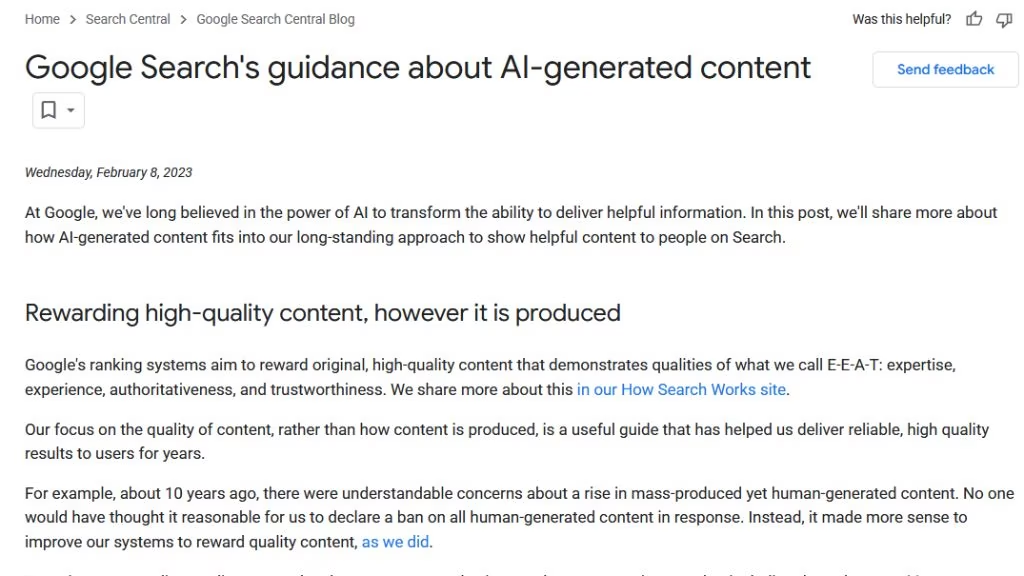
According to Google’s official documentation, their ranking systems do not focus on how content is created but on what value it delivers. If AI-generated text is spammy, thin, or misleading, it risks being filtered out under Google’s spam policies.
But if the content demonstrates expertise, satisfies search intent, and aligns with E-E-A-T (Experience, Expertise, Authoritativeness, Trustworthiness), it can rank just like human-written content.
Google also highlights three best practices:
- Add human oversight. Always review AI drafts for accuracy and tone so the final piece feels polished and trustworthy.
- Be transparent. Make sure AI-assisted content still reflects your brand’s voice and perspective.
- Prioritize people-first content. Use AI as support, but let human expertise lead to creating content that truly helps readers.
Discover how to turn generic AI text into authentic, reader-focused content in this guide: How to Prompt AI to Write Like Human.
In short, Google’s stance is clear: AI content is fine for SEO as long as it is high-quality and people-first. The tool you use does not matter but the end result does. Like any tool, AI comes with both benefits and drawbacks that can shape your SEO strategy.
The Pros and Cons of AI Content for SEO
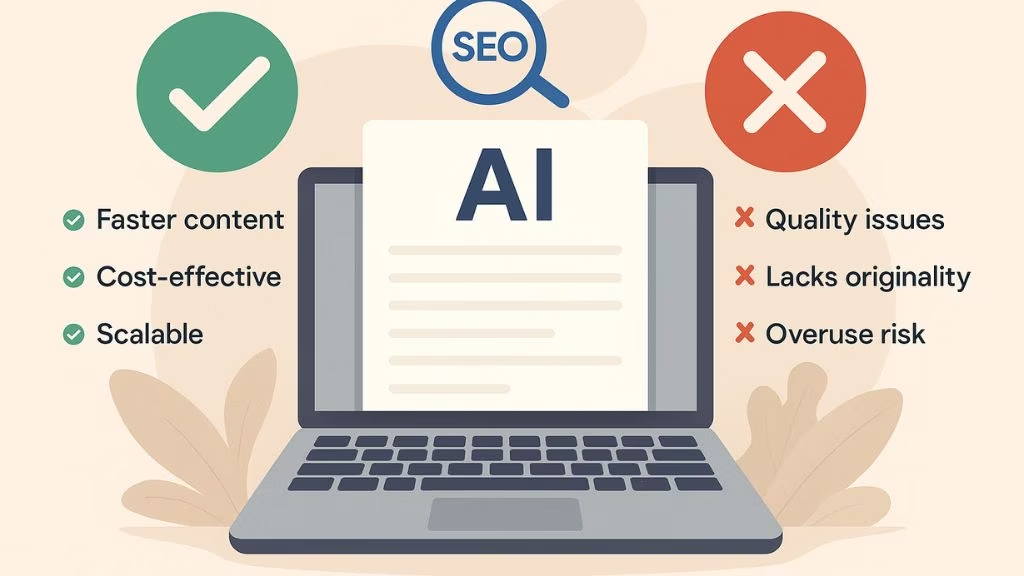
AI content can supercharge your SEO strategy, but it comes with trade-offs. Used wisely, it helps you scale faster, reduce costs, and stay competitive. Used carelessly, it can damage rankings, dilute your brand, and even get flagged by Google. Let’s break it down:
The Pros of AI Content in SEO
The biggest advantages of AI content in SEO are its speed and efficiency, making it easier to create and scale content quickly to keep up with growing demand.
Here’s how AI gives you an edge in SEO and why more marketers are leaning on it:
- Faster content production: In today’s competitive landscape, where businesses are publishing more content than ever, relying only on manual writing can put you a step behind. Using AI to speed up production helps you stay in the race, publish consistently, and target more keywords without burning out your team.
- Cost efficiency: Hiring writers, designers, or video producers can get expensive. AI lowers production costs, which means you can reallocate budget toward promotion, link building, or paid campaigns.
- Scalability: Want to build hundreds of product descriptions or blog posts around long-tail keywords? AI helps you do it at a pace that would take months manually.
- Idea generation: Even when you don’t use AI for final drafts, it’s a great brainstorming partner for headlines, subtopics, or content angles you might have missed.
- Multi-format capabilities: AI isn’t limited to text. It can generate images, infographics, video scripts, and even voiceovers which give you more ways to reach your audience and dominate search results across formats.
The Cons of AI Content in SEO
The downside of AI content in SEO is that it can feel repetitive or lack originality. Because it relies on existing data, it may generate overlapping or duplicate material, which can drag down search rankings.
Here’s where AI content can fall short and the challenges you need to watch out for:
- Quality concerns. AI drafts often sound generic and lack depth. Without editing, they risk turning into “thin content.” When I tested publishing unedited AI content, bounce rates doubled. But edited AI articles performed nearly the same as human-written ones.
- Accuracy issues. AI can sometimes “hallucinate” facts or present outdated information, which hurts trust and credibility.
- Lack of originality. Because AI predicts patterns from existing data, the content can feel repetitive. This makes it harder to stand out in competitive niches.
- E-E-A-T challenges. Google rewards experience and expertise. AI alone cannot demonstrate real-world knowledge, so human input is essential to build authority.
- Risk of overuse. Publishing AI output at scale without oversight can lead to keyword stuffing, duplication, or spam-like pages that harm long-term SEO.
Knowing the pros and cons is only useful if you also understand how to apply AI effectively.
How to Make AI Content the Right Way for SEO

AI-generated content can be a game-changer, but only if you know how to optimize AI content for SEO with strategy and oversight. Whether it’s text, images, videos, or even audio, the key is to combine AI’s speed with human oversight to create content that’s accurate, engaging, and built for users.
Here’s how to do it right across different content formats.
1. Written Content (Blogs, Articles, and Product Pages)
Most people think of AI in SEO as text generation. And yes, AI can draft blog posts, product descriptions, or landing pages in minutes. But speed means nothing if the content doesn’t rank or convert.
To get the most out of AI for written content:
- Start with search intent. Before writing, tell your AI tool who the audience is and what they’re searching for. For a blog on “best running shoes,” you can guide it to compare features, prices, and reviews instead of just listing products.
- Layer in human expertise. Use AI for structure and research, then enhance it with your own insights, examples, and case studies. This combination builds trust, satisfies Google’s E-E-A-T standards, and transforms a basic draft into SEO-friendly AI writing that ranks and connects with readers..
- Optimize naturally. Place keywords in titles, headings, and body text in a way that reads smoothly. For example, if you’re writing about running shoes, use phrases like ‘best running shoes for beginners’ or ‘lightweight marathon shoes,’ then refine them so the content feels authentic..
- For product pages: AI can create quick descriptions, but you need to guide it by highlighting your target customer and the product’s unique benefits. Then refine with real details, keywords, and persuasive copy that answers common buyer questions. This makes the page SEO-friendly while also driving conversions.
Companies that maintain a blog consistently attract more leads than those that don’t. Research published on MasterBlogging found that businesses with active blogs generate about 67% more leads compared to non-blogging companies.
If you want to learn how to create blog posts that not only attract leads but also rank higher in search, check out my guide on SEO Blog Writing: A Step-by-Step Guide for Higher Rankings.
2. Visual Content (Images, Infographics, and Graphics)
Google Image Search drives massive traffic, yet many brands ignore image SEO. AI design tools can now produce stock-style photos, infographics, and branded graphics at scale. But if you skip optimization, you’ll miss ranking opportunities.
To make AI images work for SEO:
- Always add descriptive alt text. Start by renaming your file with a slugified file name (all lowercase, words separated by hyphens, no spaces or symbols). For example, instead of saving your file as image1.png, rename it to ai-generated-infographic-seo-content-strategy.png. Then, separately, add an alt text description. You can even ask your AI: “Write an SEO-friendly alt text for this image about [topic], under 10 words, and include the keyword [keyword].” This will give you alt text that not only describes the image but also helps it appear in Google Images.
- Include context: Images perform better when supported by surrounding text and captions. To save time, try: “Generate 3 short captions for this image that explain it clearly and match an article about [topic].” This makes sure your images add meaning to the page and give search engines more context.
- Optimize for speed: Oversized visuals slow pages and hurt rankings. Use image compression tools like Squoosh or TinyPNG to reduce file size without noticeable quality loss.
Infographics aren’t just pretty visuals, they’re powerful SEO assets. According to research on infographic engagement, infographics are up to 30 times more likely to be read than articles. That means if you’re scaling visuals with AI, making sure each one is optimized for search can dramatically increase engagement and visibility.
3. Video Content (YouTube, Tutorials, and Shorts)
Video is dominating search. You’ve probably noticed Google’s “video carousel” appearing above blog posts for many queries. According to Wyzowl, 91% of businesses now use video as a marketing tool, and optimized videos often outperform text in search visibility. AI can now help create scripts, generate B-roll, and even produce voiceovers.
To make AI-driven video SEO-friendly:
- Add transcripts and captions. Google can’t watch your video, but it can read text. Ask your AI tool: “Create a transcript and short captions for this video about [topic].” That way, your video becomes searchable and more accessible to both users and search engines.
- Use optimized titles and descriptions. A vague title like “AI content tips” won’t grab attention or rank well. Instead, you could ask: “Write a YouTube title and description for this video that target the keyword [keyword] and sound engaging.” Clear, keyword-focused metadata helps your video show up for the right audience.
- Embed videos in blog posts. Adding videos to relevant articles keeps visitors on the page longer. You can prompt AI with: “Suggest the best placement for this video inside a blog post about [topic] and write a short intro for it.” This creates a natural flow between your article and video, encouraging readers to stay and engage more.
Great content starts with great prompts. If you want to level up your results, check out my guide on How to Write Better AI Prompts.
4. Audio Content (Podcasts, Interviews, and Voice Snippets)
Podcasts are exploding, and AI voice tools make production easier than ever. But for SEO, audio alone isn’t enough as search engines can’t “listen” without help.
To optimize AI-driven audio:
- Always publish transcripts: A podcast or voice clip won’t get indexed unless search engines can read it. Generate a transcript with your AI, polish it for readability, and add it to the page so your content can rank and give visitors the option to skim before listening.
- Include show notes with keywords: A podcast page should do more than just host the audio. Use your AI to create detailed show notes that summarize the episode, highlight keywords, and outline the main talking points. This gives Google extra context and helps listeners decide if the episode is worth their time.
- Expand your reach: Uploading to just one platform limits visibility. To speed this up, try: “List the best platforms to publish a podcast on [topic] and write a short description for each.” Using AI this way makes distribution easier, increases reach, and gives you more chances for backlinks.
5. Interactive Content (Quizzes, Tools, and Calculators)
Interactive content is one of the most underrated SEO assets. It keeps visitors engaged longer and often attracts natural backlinks. With AI, you can now generate quiz logic, survey questions, or even calculators in a fraction of the time.
To make interactive AI content SEO-ready:
- Solve a real problem. A mortgage calculator, an SEO quiz, or an ROI estimator gives users a reason to stay on the page and interact.
- Create an optimized landing page. Wrap the tool with keyword-rich copy, a clear H1 title, and schema markup so Google can understand and rank it properly.
Recent research from the Content Marketing Institute shows that 81% of marketers believe interactive content captures attention better than static posts. That means when you use AI to build quizzes or calculators and then optimize them for SEO, you’re creating content that not only draws clicks but keeps people engaged.
With the right human oversight, AI can create content that is accurate, engaging, and search-ready, but the real test is whether this kind of content actually ranks on Google.
Does AI Content Actually Rank on Google?
The short answer is yes — AI content can and does rank, but results depend on how it’s created and optimized. Instead of theory, let’s look at some real-world cases where AI-assisted content has performed well in search.
Causal App
According to a case study on SEO Case Study, the founder of Causal used AI at scale to generate thousands of content pages and reportedly grew to over 1 million monthly visitors in less than a year. The strategy involved identifying scalable keyword opportunities, generating drafts with AI, and refining only the content that showed performance.
Bankrate
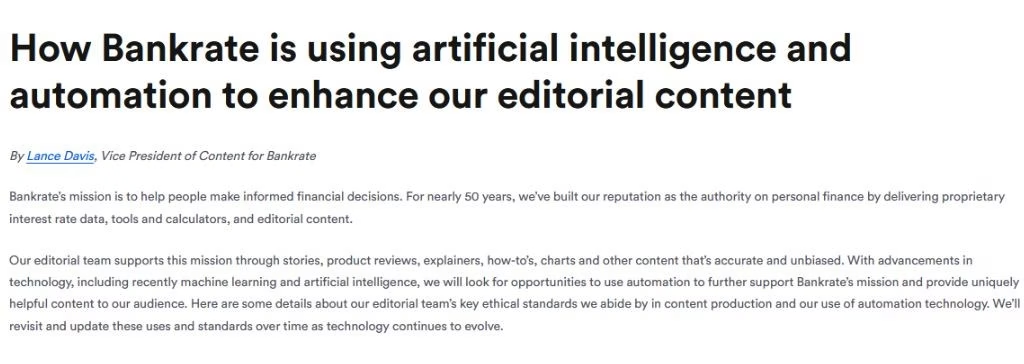
As you can see, finance site Bankrate openly disclosed that it was publishing AI-assisted articles such as “What is contribution margin?” These pieces weren’t raw AI text, editors fact-checked and refined them. Thanks to Bankrate’s domain authority and oversight, many of these articles still rank on page one.
Diggity Marketing Case Study
SEO expert Matt Diggity’s team built an “AI SEO system” that combined ChatGPT, automation, and optimization. According to Diggity Marketing, their client’s organic traffic grew by 255%, helping push monthly revenue past $491,000. AI wasn’t the only factor — but it played a big role in accelerating growth.
Case studies show that AI content can perform well in search, yet results depend on avoiding some critical mistakes.
Common Mistakes to Avoid with AI Content

AI content works best when guided by strategy and oversight. Without that, even the most advanced tools can damage your SEO instead of helping it.
Here are the key mistakes to avoid if you want your AI content to rank:
- Publishing without edits: Raw AI drafts are rarely ready for search. They often miss nuance, repeat ideas, or slip in inaccuracies. A quick human review can transform a basic draft into a polished, trustworthy article.
- Over-optimizing: Stuffing keywords or forcing awkward variations makes content unreadable. AI can suggest terms, but it’s your job to blend them in naturally so the writing feels authentic.
- Ignoring E-E-A-T: Google values expertise, authority, and real-world experience. AI can’t supply that on its own. You need to add insights, data, and examples that prove credibility.
- Scaling too fast: Publishing hundreds of AI articles without a plan often leads to thin, duplicate, or irrelevant content. Start small, refine your process, and scale only what performs well.
- Skipping user value:AI makes it easy to create text, but words alone don’t win rankings. If the content doesn’t solve a problem or answer a real question, it won’t keep readers or search engines interested.
Knowing the pitfalls makes it clear that AI is most effective when paired with strategy, which brings us to the key takeaway
Conclusion
AI isn’t here to replace search-optimized content — it’s here to redefine it. The future of SEO won’t be a battle between human vs. machine but a collaboration where creativity, data, and technology work together. Those who learn to guide AI with expertise, layer in unique perspectives, and keep their audience at the center will set the standard for what “SEO-friendly” really means.
Instead of asking ‘Can AI content rank?’ The smarter question for 2025 is ‘How can I make AI work harder for my brand than my competitors do?’ The real key lies in innovation, not imitation, and the brands willing to embrace that mindset will own the search results of tomorrow.
To understand how AI fits into the bigger picture of digital growth, read my article on How to Build a Winning AI Marketing Strategy.
FAQs
Can Google detect AI-generated content?
Google may recognize AI patterns, but detection isn’t what matters. Rankings depend on quality, originality, and usefulness, not on whether content is AI-written or human-written.
Does using AI content violate Google’s guidelines?
No. Google allows AI content if it’s helpful, accurate, and people-first. Only spammy, low-quality, or manipulative AI pages risk penalties.
How much human editing is needed for AI content to rank?
Every AI draft should be reviewed. Fact-checking, adding insights, and refining tone ensure content meets search intent, builds trust, and ranks effectively.
How do I optimize AI-generated content for Google?
The key is to optimize AI content for SEO by editing drafts, adding unique insights, and using natural keyword placement so it remains both useful and rankable.
Will AI replace human writers in SEO?
No. AI speeds up writing, but it can’t match human creativity, authority, or experience. SEO success still relies on human expertise guiding the process.
This page was last edited on 30 November 2025, at 2:38 pm