
You open your laptop with a plan to write a blog post.
You’ve chosen a keyword. Maybe you’ve even checked search volume. You tell yourself, “I’ll start writing and fix things later.”
But 30 minutes in, you’re stuck!
You’re not sure what angle to take, which sections actually matter, or whether this post will rank or quietly disappear after publishing.
If you’re a blogger, content marketer, or freelancer, this probably feels familiar.
The problem isn’t your writing skills. And it’s not that you don’t understand SEO.
The real issue is simpler: you’re starting without a clear SEO content brief.
Without a solid brief, content becomes guesswork. Writers go off track. Edits pile up. And even after hitting “publish,” there’s that lingering doubt, did this really match what users and Google want?
This is where AI changes everything.
Used correctly, AI doesn’t just help you write faster; it helps you plan smarter. It can uncover search intent, analyze what’s already ranking, organize content structure, and turn a messy idea into a clear roadmap.
In this guide, you’ll learn how to create an SEO content brief using AI, step by step. By the end, you’ll have a repeatable process to plan content that’s focused, strategic, and ready to rank.
What Is an SEO Content Brief?
An SEO content brief is a strategic guide that defines search intent, analyzes the SERP, and outlines content structure, keywords, and optimization requirements before writing begins. When created using AI, it applies semantic SEO, content optimization, and E-E-A-T principles to help content align with user expectations and ranking factors.
In practice, an SEO content brief brings together insights like heading hierarchy (H1-H3), internal and external links, title tag and meta description guidance, and topical coverage based on People Also Ask and competitor analysis. By using AI technologies such as natural language processing (NLP) and large language models (LLMs), teams can create more consistent, data-driven briefs that reduce guesswork and improve organic performance.
What Is Always in a Top-ranking SEO Content Brief?
Before jumping into tools or AI workflows, it’s important to understand what actually makes an SEO content brief work. No matter the industry or keyword, top-ranking pages are built on briefs that follow a clear, repeatable structure. These elements act as the foundation; they guide search engines, writers, and AI tools in the same direction and ensure the content matches both user intent and SERP expectations.
Here are the core components you’ll always find in a top-ranking SEO content brief:
- Keyword Focus: A clearly defined primary keyword, supported by relevant secondary and long-tail keywords, chosen to strengthen semantic SEO and topical authority rather than keyword stuffing.
- Search Intent: A precise explanation of what the user wants to achieve, like informational, transactional, or commercial, translated into content requirements, format, and depth.
- Target Audience: A specific user persona that defines who the content is for, including their experience level, pain points, and expectations from the page.
- SERP Insights: Key observations from the Search Engine Results Page, such as common subtopics, content formats, and gaps competitors haven’t covered well.
- Content Structure: A defined heading hierarchy (H1, H2, H3) that outlines the flow of the article and ensures clarity, scannability, and logical progression.
- Semantic Topic Coverage: Related concepts and subtopics that support the main topic and help search engines understand contextual relevance.
- Optimization & Trust Signals: Guidelines for title tags, meta descriptions, internal and external links, and E-E-A-T elements that improve credibility and performance.
Now that you know what must be inside a winning brief, the natural question is, how do you actually create one without overthinking it? Let’s walk through the process together, step by step.
Step-by-step Process of Creating an SEO Content Brief
Now that you know what goes into a top-ranking SEO content brief.
Let’s walk through how to actually create one using AI with step-by-step. Think of this as a guided workflow that takes you from a vague idea to a clear, search-ready content plan.
Step 1: Define Goal & Audience Persona
Before AI writes a single line or you look at keywords, you need to decide why this content exists and who it’s really for. Skipping this step is like opening Google Maps without entering a destination; you might move fast, but you won’t get anywhere useful.
Most people jump straight into AI tools and hope the output “sounds right.” But when the goal is unclear, AI produces content that tries to please everyone and ends up connecting with no one. That’s why defining the goal and audience persona is the foundation of an effective SEO content brief.
Clearly Define the Content Goal
Start with the content goal. This isn’t about rankings yet; it’s about intent from your side. Are you trying to educate beginners, provide a practical workflow, or introduce a solution that simplifies the process? The goal influences how detailed the content should be, how examples are used, and where CTAs naturally fit into the flow.
Identify the Target Audience Persona
Next, think about the person reading this content. Your User Persona should feel like a real human, not a demographic label. It might be a blogger struggling with content planning, a content marketer managing multiple writers, or a WordPress user looking to speed up publishing. When you understand their pain points, your content becomes more relatable and far more useful.
To turn this clarity into action, your brief should clearly state:
- The primary goal of the page
- Who the content is written for
- The level of SEO or AI knowledge to assume
Once this step is done properly, AI stops guessing and starts executing with purpose. Every section that follows becomes clearer, more focused, and easier to optimize, setting you up perfectly for the next step: researching keywords and locking search intent.
Step 2: Research Keyword & Lock Search Intent
Once your goal and audience are clear, the next step is choosing the right keyword and locking the search intent behind it. This is where many AI-generated SEO content briefs go wrong, not because the keyword is bad, but because the intent is unclear.
Keyword research isn’t just about search volume or keyword difficulty. It’s about understanding why someone is searching. For the same topic, users may want an explanation, a step-by-step guide, or a ready-to-use template. If your brief doesn’t define this upfront, the content can feel misaligned even if it’s well written.
Start by selecting one primary keyword and a few closely related terms to support semantic coverage. Then clearly identify the dominant Search Intent, informational, transactional, or commercial, and what outcome the reader expects.
At this stage, your brief should state:
- The primary keyword and key variations
- The locked search intent
- The reader’s expected takeaway
When intent is locked early, AI writes with direction instead of guessing.
Step 3: Analyze the global SERP
Now that search intent is locked, it’s time to reality-check your ideas against the SERP. This step isn’t about copying competitors; it’s about understanding what already works so your brief meets baseline expectations.
Start by reviewing the top-ranking pages for your target keyword across different regions, if possible. Pay attention to patterns rather than individual pages. Are most results long-form guides, step-by-step tutorials, or template-based posts? Do they focus more on strategy, execution, or tools?
As you analyze the SERP, look for:
- Repeated subtopics and section headings
- Common content formats (lists, workflows, FAQs)
- Gaps where explanations feel shallow or outdated
This process helps you identify the minimum coverage required to compete, while also spotting opportunities to add information gain and originality.
AI can assist by summarizing SERP patterns quickly, but your brief should document the insights clearly. When SERP analysis is done right, your content brief stops guessing and starts aligning with how search engines and users already behave.
Once this step is complete, you’re ready to extract real user questions and intent signals from the SERP.
Step 4: Extract People Also Ask & Intent Questions
After analyzing the SERP, the next step is to listen more closely to users by focusing on the questions they’re already asking. This is where the People Also Ask section becomes incredibly valuable.
People Also Ask reveals the doubts, follow-up questions, and clarifications users need before they feel satisfied. Ignoring these questions often leads to content that feels incomplete, even if it covers the main topic well.
Start by collecting recurring questions from the SERP and grouping them by intent. Some questions belong in the main content as sub-sections, while others are better suited for an FAQ section. This helps you plan content flow and ensures important answers appear at the right moment in the reading journey.
AI can quickly extract and cluster these intent-based questions, saving time and reducing manual work. However, your brief should clearly specify which questions must be answered and how deeply they should be covered.
At this stage, your SEO content brief should include:
- Key People Also Ask questions
- Related intent-driven queries
- Notes on where each question fits in the structure
When these questions are built into the brief, the content feels more complete, helpful, and aligned with real user needs.
Step 5: Build a Semantic Topic Map (Topic Cluster)
Once you know what users are asking, the next step is to zoom out and look at the topic as a whole. This is where you build a semantic topic map, a structured way to cover a subject deeply instead of focusing on a single keyword.
Search engines don’t rank pages based on one phrase alone. They look for context, relationships, and topical authority, which is the foundation of Semantic SEO. A topic cluster helps you show that your content understands the subject from multiple angles.
Start by defining the core topic (the pillar) and then map out supporting subtopics that naturally connect to it. These might include processes, examples, tools, common mistakes, or related concepts users expect to see. This structure also helps you plan internal links between related pages, strengthening site-wide relevance.
AI can assist by identifying related concepts and clustering them logically, but your brief should clearly document which topics are essential and how they connect.
At this stage, your SEO content brief should outline:
- The primary topic (pillar)
- Supporting subtopics (cluster content)
- How these topics reinforce each other
With a semantic topic map in place, your content is positioned to compete on depth, not just keywords.
Step 6: Generate a SERP-Based Outline with AI
Now that your topics are mapped and the intent is clear, it’s time to turn strategy into structure. This is where AI becomes especially useful, not for writing the content yet, but for organizing it intelligently.
Using AI powered by Large Language Models, you can generate an outline that reflects real SERP patterns instead of guesswork. The goal is to create a logical flow that matches what users expect to see when they search this topic.
Ask AI to produce a structured outline with a clear heading hierarchy (H1, H2, H3) based on:
- Common sections found in top-ranking pages
- People Also Ask questions
- Your semantic topic map
The result should be a clean content skeleton that shows what comes first, what deserves deeper explanation, and where examples or templates belong.
AI can generate this outline in seconds, but it’s important to review and refine it. Look for opportunities to improve clarity, remove redundancy, and add information gain. Once finalized, this outline becomes the backbone of your SEO content brief and makes the writing process faster and far more focused.
Read More: How to Generate SERP-based Outlines Using AI
Step 7: Add On-Page Optimization Checklist
At this point, your SEO content brief has direction and structure. Now it’s time to make sure the content is actually search-ready. This is where an on-page optimization checklist comes in; it turns strategy into clear execution rules.
Instead of leaving SEO decisions to chance, top-ranking briefs spell out exactly how the page should be optimized. This helps writers and AI tools focus on quality without forgetting critical details that influence visibility.
Your checklist should clearly define essentials like the Title Tag angle and Meta Description goal, so the page is optimized for click-through rate from the SERP. It should also guide how Internal Links and External Links are used to support context and credibility.
At a minimum, this step should outline:
- Title and meta direction
- Internal and outbound linking rules
- Recommended word count and formatting
- Basic readability and scannability guidelines
By baking Content Optimization into the brief, you reduce revisions and ensure the content is optimized correctly from the very first draft.
Step 8: Include Brand Voice and Writing Instructions
At this stage, your SEO content brief may be technically strong, but without clear writing guidance, the final content can still feel off. This step ensures the content doesn’t just rank, but also sounds consistent, human, and on-brand.
Start by defining your Brand Voice. Should the tone be conversational or authoritative? Beginner-friendly or expert-led? Clear voice instructions help writers and AI tools avoid generic, robotic output and maintain consistency across your content.
Next, include practical writing instructions that remove ambiguity. This might involve the preferred reading level, formatting style, or how examples should be used. For AI-assisted writing, these instructions act as guardrails, guiding structure, clarity, and flow.
Your brief should clearly state:
- Tone and style expectations
- Level of SEO and AI knowledge to assume
- Formatting preferences (paragraph length, lists, examples)
- Writing “do’s and don’ts” (avoid fluff, keyword stuffing, or vague claims)
When brand voice and writing rules are documented upfront, content creation becomes smoother. Writers need fewer revisions, AI outputs improve instantly, and every article feels like it belongs to the same brand, no matter who (or what) writes it.
Step 9: Add an E-E-A-T and Quality Checklist
By now, your brief has structure, intent, and optimization baked in, but one critical layer is still missing: trust. This step ensures your content meets quality standards that both users and search engines care about.
This is where E-E-A-T comes into play with Experience, Expertise, Authoritativeness, and Trustworthiness. Especially for AI-assisted content, these signals help prevent pages from feeling generic or unreliable.
Instead of leaving quality up to chance, your brief should clearly document what needs to be proved, not just stated. That might include first-hand experience, real examples, credible references, or practical demonstrations that show the content is written with genuine understanding.
Your checklist should answer questions like:
- What experience or expertise should be reflected?
- Are there facts or claims that need verification?
- Should examples, screenshots, or real-world use cases be included?
- What sources should be cited for credibility?
When E-E-A-T and quality guidelines are defined upfront, AI becomes safer and more effective. The result is content that feels reliable, useful, and worth ranking, rather than just well-optimized.
Step 10: Publish & Measure Performance
Once your content goes live, the SEO content brief doesn’t disappear; it moves into its final role: evaluation. This step helps you understand whether your planning decisions actually worked in the real world.
After publishing, ensure the page is indexed and tracked properly. Using tools like Google Search Console, you can see how the page appears in search results and how users respond to it. This is where your brief proves its value.
Instead of obsessing over rankings alone, focus on performance signals that reflect intent alignment and user experience. Metrics such as Click-Through Rate, Organic Traffic, and Bounce Rate tell a much clearer story.
At this stage, your analysis should answer:
- Are users clicking the page from the SERP?
- Are they staying and engaging with the content?
- Does the page satisfy the original search intent?
If something underperforms, treat it as feedback, not a failure. Use these insights to refine headings, structure, or optimization rules in your next SEO content brief. This is how the process becomes smarter with every publish.
Seeing the process laid out makes it feel doable, right? The next piece of the puzzle is knowing which AI tools can help you apply these steps faster without cutting corners.
Key AI Tools to Create SEO Content Briefs
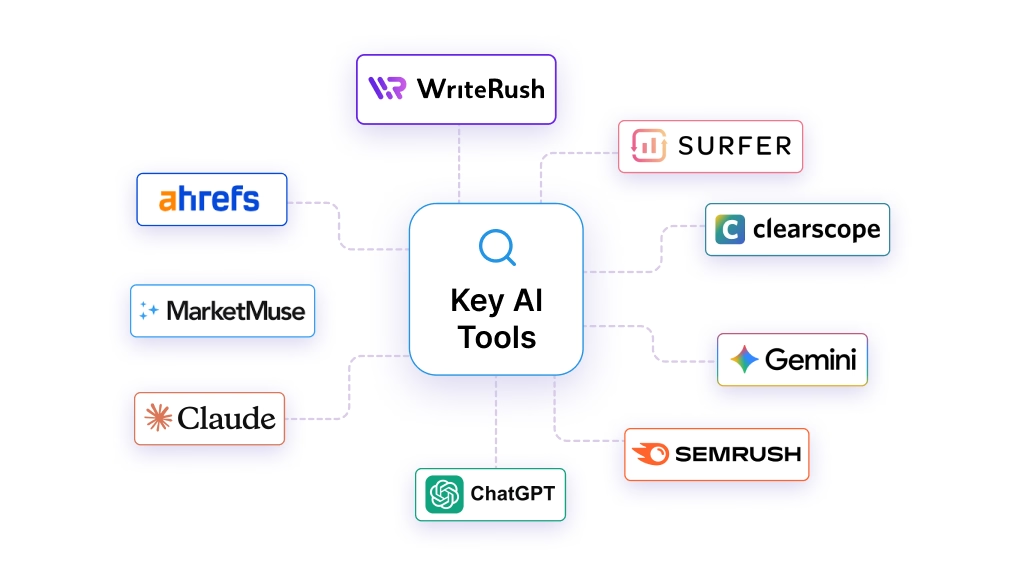
Once you understand how an SEO content brief is structured, the next question is which AI tools can actually help you create one efficiently. The good news is that you don’t need a single “perfect” tool; different AI tools support different parts of the process, from SERP analysis and topic mapping to outlining and optimization.
Below are some of the most popular AI tools used by bloggers, content marketers, and WordPress users to create data-driven, search-focused SEO content briefs.
All-in-One SEO & Content Brief Tools
These tools focus on SERP analysis, semantic coverage, and optimization guidance.
- Surfer SEO: Generates SERP-based outlines, keyword recommendations, and on-page optimization checklists.
- Clearscope: Strong in NLP-driven semantic topic analysis and aligning briefs with top-ranking content.
- MarketMuse: Ideal for building topical authority, topic clusters, and in-depth SEO content briefs at scale.
AI Writing & Prompt-Based Tools
These tools rely heavily on prompt engineering and editorial direction.
- ChatGPT: Flexible for search intent analysis, SERP-based outlines, topic mapping, and custom SEO briefs.
- Claude: Useful for structured thinking, long-form planning, and quality-focused briefs.
- Gemini: Helpful for intent analysis and understanding how Google-style SERPs behave.
SEO Research Tools That Support Brief Creation
Often used alongside AI writers to strengthen strategy.
- Ahrefs: Excellent for keyword research, SERP analysis, and competitor insights.
- Semrush: Provides intent classification, SERP data, and SEO content templates.
WordPress AI Plugins (End-to-End Workflow)
Best for users who want planning, writing, and optimization in one place.
- Writerush: A WordPress AI content writing plugin designed to create content briefs, outlines, and optimized drafts directly inside the WordPress editor. Writerush helps users lock search intent, generate structured content plans, and maintain brand voice, without switching between multiple tools.
Tools are helpful, but only when you know what to ask them. That’s why the next section gives you a copy-paste template and prompts you can start using immediately.
Copy-Paste Template with Prompts: AI SEO Content Brief
By now, you understand the why and the how. The next step is making this process repeatable. That’s exactly what a copy-paste AI SEO content brief template does: it turns strategy into a system you can reuse for every blog post.
This template is designed to work with AI tools powered by Natural Language Processing (NLP) and Large Language Models (LLMs), so the clearer your inputs are, the better the output will be. Think of this as structured prompt engineering for SEO planning.
AI SEO Content Brief Template (Fill-in Format)
- Content Goal: What is the primary objective of this page (educate, rank, convert, support a product)?
- Target Audience / User Persona: Who is this content for, and what problem are they trying to solve?
- Primary Keyword: Main keyword to target.
- Supporting Keywords & Semantic Topics: Related terms to support semantic SEO and topical authority.
- Search Intent: Define the dominant Search Intent (informational, transactional, or commercial) and what the user expects by the end of the content.
- SERP Insights: Key observations from the SERP, common sections, formats, and gaps to improve information gain.
- Required Content Structure: Planned heading hierarchy (H1-H3) and section flow.
- People Also Ask & Key Questions: Important People Also Ask (PAA) and intent-based questions to answer.
- Internal & External Links: Pages to link internally and credible outbound references.
- Title Tag & Meta Description Direction: Guidelines to improve click-through rate.
- E-E-A-T & Quality Notes: Experience signals, examples, sources, and fact-checking requirements.
- Brand Voice & Writing Instructions: Tone, formatting preferences, and do’s/don’ts.
Sample AI Prompt You Can Reuse
“Create an SEO content brief for the keyword [X]. Analyze search intent, SERP patterns, PAA questions, and semantic topics. Generate a structured outline, optimization checklist, and E-E-A-T guidelines for [target audience].”
This format ensures AI doesn’t just generate content; it plans content strategically. By combining intent, SERP data, structure, and quality signals in one place, you get SEO content briefs that are clearer, faster to execute, and far more likely to perform.
This is where everything clicks, but imagine how much easier this gets when you don’t have to jump between tools. Let’s talk about how doing this directly in WordPress changes the game.
How a WordPress AI Plugin Makes Briefs Faster
At this point, you might be thinking: “This process makes sense, but doing all of it manually still sounds time-consuming.”
That’s exactly where a WordPress AI writing plugin changes the workflow.
Instead of jumping between keyword tools, documents, and editors, an AI plugin brings the entire SEO content brief process inside your CMS. For teams and solo creators alike, this removes friction and speeds up planning without sacrificing quality.
From Disconnected Tools to a Single Workflow
Traditionally, creating an SEO content brief involves switching between research tools, spreadsheets, and writing apps. A WordPress AI plugin streamlines this by combining content planning, structure, and optimization in one place.
Using Generative AI, Natural Language Processing (NLP), and Large Language Models (LLMs), these plugins can analyze search intent, interpret SERP patterns, and suggest structured outlines directly in the editor.
With an AI-powered WordPress plugin, you can:
- Generate SERP-based content structures and heading hierarchy
- Identify People Also Ask questions and semantic topics
- Create title tags and meta descriptions optimized for CTR
- Apply on-page content optimization rules automatically
- Maintain consistent brand voice across posts
All of this happens without leaving WordPress.
Speed feels great, but only when the quality holds up. Before you rely too heavily on AI, let’s quickly cover the common mistakes that can quietly sabotage your briefs.
Common Mistakes When Using AI for SEO Briefs
AI can dramatically speed up how you create SEO content briefs, but only if it’s used with intention. When results fall flat, it’s usually not because AI is “bad,” but because a few critical steps were skipped or misunderstood.
Let’s walk through the most common pitfalls and how to fix them.
Mistake 1: Letting AI Decide Search Intent
One of the biggest mistakes is asking AI to generate a brief without first locking Search Intent. AI can analyze patterns, but intent is a strategic decision. If intent is unclear, the brief may mix formats, miss expectations, or target the wrong outcome.
Fix: Define intent (informational, transactional, or commercial) before generating structure.
Mistake 2: Copying the SERP Instead of Learning From It
Another common issue is turning SERP analysis into imitation. This leads to lookalike content with little information gain.
Fix: Use SERP insights to meet baseline coverage, then add originality, examples, or clearer explanations.
Mistake 3: Overloading Briefs With Keywords
Stuffing a brief with keywords and LSI terms often hurts readability and focus. Modern SEO favors semantic SEO, not repetition.
Fix: Map topics logically and focus on coverage, not counts.
Mistake 4: Ignoring E-E-A-T and Quality Signals
AI-generated briefs sometimes skip trust elements like experience, sources, or verification, weakening E-E-A-T.
Fix: Add a clear quality checklist, like what to prove, cite, or demonstrate.
Mistake 5: Treating the Brief as “One and Done”
Finally, many teams never revisit the brief after publishing. That means missed insights from performance data like Click-Through Rate or Bounce Rate.
Fix: Use results to refine future briefs.
If you avoid these pitfalls, AI becomes a real advantage instead of a risk. With that clarity, it’s time to step back and see how all of this fits together.
Final Thoughts
Creating strong SEO content starts long before writing; it starts with a clear brief. When AI is used strategically, it helps you plan content with purpose, not guesswork. By combining search intent, SERP insights, semantic topic coverage, and structured optimization, you can turn ideas into focused, high-performing content plans.
AI tools powered by NLP and large language models don’t replace SEO strategy; they speed it up. When goals, audience, structure, and quality standards are defined upfront, AI becomes a reliable assistant that improves consistency and saves time.
The real advantage comes from guidance. With a well-defined SEO content brief, bloggers, content marketers, and WordPress users can create content that aligns with user expectations, supports E-E-A-T, and performs better in search, every single time.
Frequently Asked Questions (FAQs)
1. What should an SEO content brief include?
An SEO content brief should include search intent, target keywords, SERP insights, content structure (H1-H3), semantic topics, internal and external links, on-page optimization notes, and E-E-A-T guidelines to ensure clarity and alignment before writing.
2. How does AI help in creating SEO content briefs?
AI helps by analyzing search intent, summarizing SERP patterns, extracting People Also Ask questions, generating content structures, and organizing semantic topics faster using NLP and large language models.
3. Is an AI-generated SEO content brief accurate?
AI-generated briefs can be highly accurate when guided properly. However, human oversight is still needed to lock search intent, refine structure, and ensure quality, originality, and E-E-A-T compliance.
4. What is the difference between a content brief and a content outline?
A content brief is a strategic document that includes intent, SEO requirements, structure, and quality guidelines, while a content outline focuses mainly on headings and section flow.
5. How long should an SEO content brief be?
There’s no fixed length, but a good SEO content brief is detailed enough to guide writing without ambiguity, usually one to two pages covering strategy, structure, and optimization.
6. Can beginners use AI to create SEO content briefs?
Yes. AI makes it easier for beginners by simplifying SERP analysis, intent research, and content structuring, especially when using guided templates or WordPress AI plugins.
7. Do SEO content briefs help content rank faster?
SEO content briefs don’t guarantee rankings, but they significantly improve alignment with search intent, SERP expectations, and on-page optimization, making content more competitive from the start.
8. Is a WordPress AI plugin better for creating SEO content briefs?
For WordPress users, AI plugins offer a faster workflow by generating briefs, outlines, and optimization guidance directly inside the CMS, reducing context switching and improving consistency.
This page was last edited on 30 January 2026, at 4:12 pm