You open a blank Google Doc.
You have a keyword.
You want to write something great.
But then it hits.
What should the headings be? Which subtopics matter?
Why did your last “well-written” blog never rank?
If you’ve ever stared at your screen, guessing section titles and hoping Google “gets it,” you’re not alone. Bloggers, content marketers, and even experienced SEO pros struggle with the same problem: creating content without a clear roadmap.
Most blogs don’t fail because the writing is bad. They fail because the structure doesn’t match what people, and Google, actually expect.
That’s where SERP-based outline creation changes everything.
Instead of guessing what to write, you learn how to read Google’s clues, understand search intent, and build outlines that are already aligned with top-ranking content.
In this guide, you’ll learn how to create SERP-based outlines manually by reading Google’s search results, identifying search intent, analyzing competing pages, studying People Also Ask questions, and organizing your content structure before writing.
If you want to automate this workflow later, you can use AI tools. But first, this guide will show you the manual process so you understand the strategy behind every outline.
What Is SERP-Based Outline Creation?
SERP-based outline creation is the process of building a content outline by analyzing Google Search results to understand search intent, extract common topics, and structure an SEO content brief in a way that aligns with what already ranks.
Instead of inventing headings from scratch, this method uses SERP analysis to identify what Google considers relevant, comprehensive, and helpful for a specific query.
In practice, SERP-based outline creation means studying top-ranking pages, People Also Ask questions, and featured snippets to design a content outline that mirrors real user expectations. Today, as Google prioritizes semantic SEO and helpful content, this approach ensures your content isn’t just well-written; it’s strategically structured to perform.
Why Traditional Content Outlines Often Fail
Traditional content outlines usually start with an introduction. You map out a few headings, arrange them in a logical order, and move on to writing. That’s where the issue begins. These outlines are often created without checking how Google Search actually interprets and ranks content today.
In practice, traditional content outlines rely heavily on guesswork. Writers assume what readers want instead of validating ideas through SERP analysis. As a result, the structure may look organized, but it often fails to align with real search intent, the underlying reason someone searched in the first place. This is why many blogs fail to rank even when the writing itself is solid.
Now here’s what often gets missed. Google clearly signals expectations through SERP features like Featured Snippets and People Also Ask. Traditional outlines tend to ignore these cues, which means the content doesn’t answer questions in the formats Google prefers. When those signals are overlooked, visibility suffers.
Another common problem is shallow topical coverage. Without semantic SEO, outlines miss related concepts and supporting context. This weakens topical authority and limits EEAT (Experience, Expertise, Authoritativeness, Trustworthiness) signals, making it harder for Google to trust the content as comprehensive.
As a result, traditional outlines often struggle because they:
- Are based on assumptions instead of SERP data
- Miss intent-driven questions that users actually care about
- Ignore SERP features that influence rankings
This growing gap between traditional outlining methods and how Google evaluates content is exactly why SERP-Based Outline Creation has become the smarter, more reliable approach.
How Google SERPs Reveal the Ideal Content Structure
Now here’s the interesting part.
Google’s search results are not random. Every ranking page is a data point.
When you search for a keyword and see similar headings across multiple results, Google is telling you something.
Pay attention to:
- Repeated H2 and H3 topics
- Question-style headings
- Step-by-step formats
- Comparison tables or lists
- FAQs and short answers
For example, if most top pages include:
- A definition
- A step-by-step process
- A tools section
- FAQs
Then skipping those sections is a risk.
SERPs also reveal intent through features like:
- Featured snippets → concise definitions or steps
- People Also Ask → real user questions
- AI Overviews (SGE) → conversational, answer-first content
Reading SERPs is like reading Google’s blueprint for content.
Step-by-Step: How to Create a SERP-Based Outline Manually
This is where the process really comes to life. Unlike traditional content outlines that rely on instinct or past habits, SERP-Based Outline Creation is rooted in observation. You’re not guessing what to write; you’re learning directly from Google Search what works.
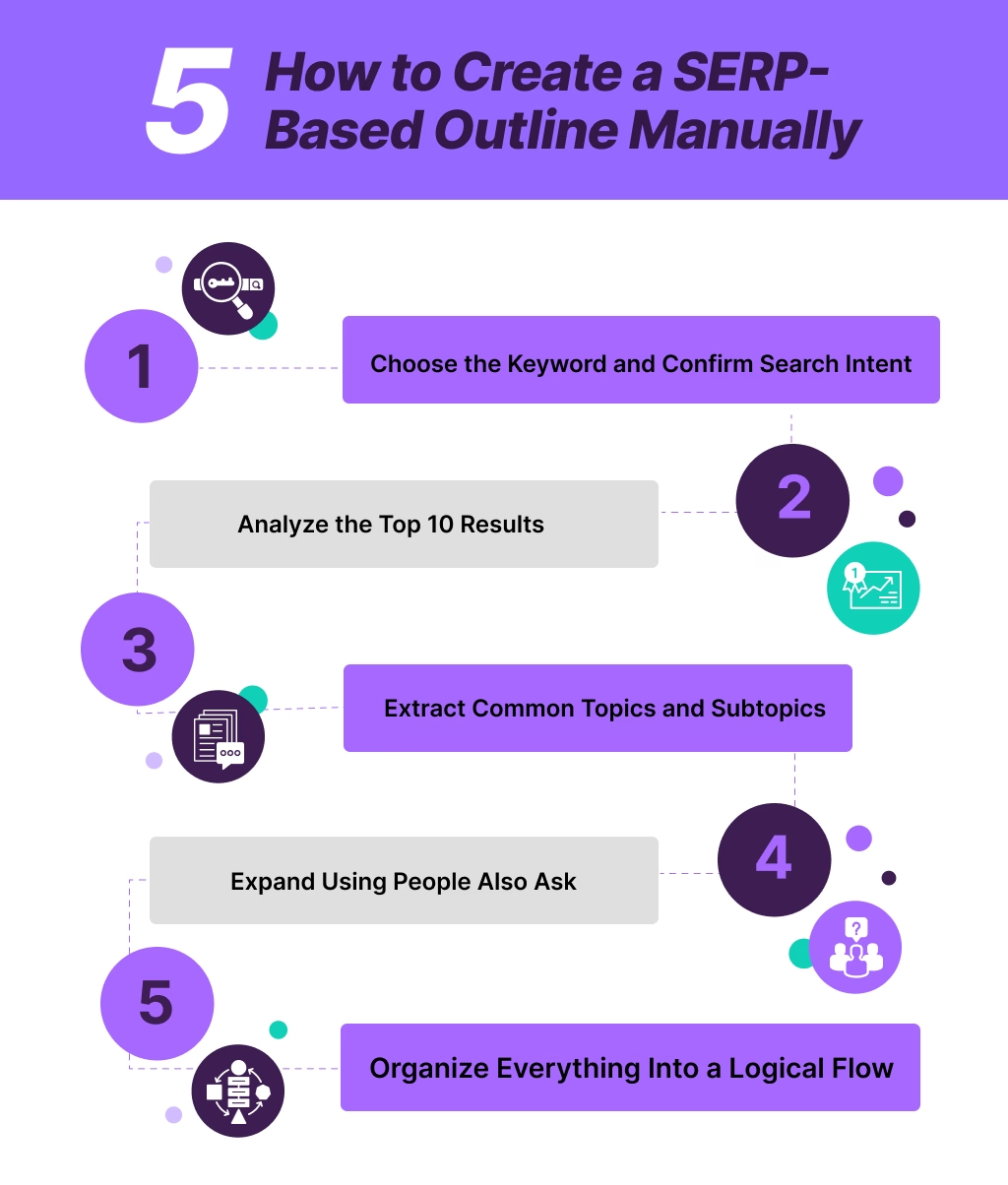
Let’s break this down into a simple, repeatable process.
Step 1: Choose Your Target Keyword
Start with one clear target keyword.
Your target keyword should represent the main topic of the article. If the keyword is too broad, your outline may become unfocused. If the keyword has mixed intent, your article may try to answer too many different needs at once.
For example, a keyword like “content outline” is broad. Users may be looking for a definition, a template, examples, or a tool. A more focused keyword like “how to create a content outline” gives you a clearer direction because the user wants a step-by-step process.
Before creating the outline, ask:
- What is the main keyword?
- What problem is the user trying to solve?
- Is this keyword suitable for one article, or should it be split into multiple pages?
- Are users looking for information, comparison, a template, a tool, or a tutorial?
Avoid targeting multiple intents in the same article. For example, “what is a SERP-based outline” and “best AI outline generator” should not be treated as the same topic. One is informational, while the other is commercial.
A focused keyword leads to a focused outline.
Step 2: Identify Search Intent
After choosing the keyword, search it on Google and study the type of results that appear.
Search intent tells you what users want when they type that keyword. If your content does not match the intent, even a well-written article may struggle to rank.
Common search intent types include:
| Intent Type | What the User Wants | Example Keyword |
|---|---|---|
| Informational | To learn or understand something | what is a SERP-based outline |
| Tutorial | To follow a process | how to create a SERP-based outline |
| Commercial | To compare options before choosing | best content outline tools |
| Transactional | To buy, download, or sign up | content outline generator free |
| Comparison | To compare two or more options | Surfer SEO vs Frase |
| Template-based | To find a ready-made format | blog outline template |
Look at the first page of Google and identify the dominant pattern. Are most results guides, listicles, product pages, templates, or comparison posts?
For example, if the top results are mostly “how-to” guides, your content should also follow a tutorial structure. If the top results are tool roundups, a basic educational article may not match the intent.
This step helps you decide the correct content format before writing the outline.
Step 3: Analyze the Top-Ranking Pages
Next, review the top 5–10 organic results for your target keyword.
Do not only look at the titles. Open the pages and study how they are structured. Your goal is to understand what successful pages have in common and what they are missing.
Pay attention to:
- Content type: blog post, landing page, comparison guide, template, checklist, or tutorial
- Content format: step-by-step guide, listicle, beginner guide, case study, or product page
- Content angle: beginner-friendly, advanced, fast method, free method, tool-based, or expert guide
- Depth: short overview or detailed long-form guide
- Heading structure: how they organize H2s and H3s
- Examples: whether they include samples, screenshots, templates, or visuals
- FAQs: what questions they answer near the end
- CTAs: whether they push a product, template, newsletter, or service
Create a simple note sheet while reviewing the pages. For each ranking page, write down:
Page title:
Content type:
Main angle:
Important H2s:
Unique sections:
Missing information:
This helps you see patterns more clearly.
For example, if most ranking pages include sections about search intent, competitor analysis, People Also Ask, and outline templates, those are important subtopics. But if none of them include a real manual example, that becomes an opportunity for your article to stand out.
Step 4: Extract Common Headings and Topics
After reviewing the ranking pages, collect the repeated headings and topics.
This does not mean copying competitors’ H2s word for word. Instead, look for patterns.
For example, you may notice that several ranking pages include topics like:
- What is a SERP-based outline?
- Why SERP analysis matters
- How to identify search intent
- How to analyze competitor headings
- How to use People Also Ask
- How to organize an SEO content outline
- Common mistakes to avoid
These repeated topics show what users likely expect from a complete guide.
Group similar headings together. For example:
| Competitor Heading Pattern | Your Improved Section |
|---|---|
| What is a content outline? | What Is SERP-Based Outline Creation? |
| Why outlines matter for SEO | Why SERP-Based Outlines Improve SEO Content Planning |
| Analyze competitors | How to Analyze Top-Ranking Pages Before Writing |
| Use PAA questions | How to Use People Also Ask in Your Outline |
| Mistakes | Common SERP-Based Outline Mistakes to Avoid |
Your goal is to create a better structure, not a duplicate structure.
A strong outline should include the important topics users expect, but it should also add your own angle, examples, and expertise.
Step 5: Review SERP Features
SERP features are the extra elements Google shows on the results page besides regular blue links.
These features reveal what kind of information users want quickly.
Check for:
- Featured Snippets
- People Also Ask questions
- Related searches
- Videos
- Images
- Local results
- Product results
- Reviews
- Comparison tables
- “Things to know” panels
For a SERP-based outline, People Also Ask and Featured Snippets are especially useful.
If there is a Featured Snippet, study what format Google is highlighting. Is it a definition, list, table, or step-by-step answer? This can guide how you structure your own section.
If there are People Also Ask questions, collect the most relevant ones and decide where they fit. Some questions can become H2 sections. Others can be added to the FAQ section.
For example, if you are writing about SERP-based outline creation and the SERP shows questions like:
- What is a content outline?
- How do you structure a blog post?
- What should an SEO outline include?
- How do you analyze search intent?
You can use these questions to make your outline more complete.
Related searches can also help you find supporting subtopics. They often reveal how users continue their search after the first query.
Step 6: Add Semantic Topics and Content Gaps
Now, improve the outline by adding related topics and missing angles.
Semantic topics are concepts closely connected to your main keyword. They help your article cover the topic more naturally and completely.
For a topic like SERP-based outline creation, useful semantic topics may include:
- Search intent
- SEO content brief
- Keyword mapping
- Competitor analysis
- Heading structure
- Content gaps
- Topical relevance
- People Also Ask
- Featured Snippet
- Internal linking
- EEAT
- Blog outline template
You should not force these terms into the article. Use them only where they genuinely help the reader.
Next, look for content gaps. A content gap is something important that competitors did not explain well.
For example, competing pages may explain what SERP-based outlines are, but they may not include:
- A real outline example
- A manual checklist
- A downloadable template
- A comparison between traditional and SERP-based outlines
- A section on mistakes to avoid
- A clear process for organizing H2s and H3s
- Tips for avoiding keyword cannibalization
These gaps are opportunities.
Your outline should cover the expected topics and add something extra that makes your article more useful than what already ranks.
Step 7: Organize the Final Outline
Once you have collected search intent, competitor topics, SERP features, semantic terms, and content gaps, arrange everything into a logical structure.
A good outline should guide the reader from basic understanding to practical action.
For most educational SEO articles, this structure works well:
- Define the topic
- Explain why it matters
- Show what to analyze
- Give a step-by-step process
- Provide an example
- Add a checklist or template
- Explain common mistakes
- Answer FAQs
- End with a clear conclusion or CTA
For example:
# SERP-Based Outline Creation: Manual SEO Content Planning Guide
## What Is SERP-Based Outline Creation?
## Why SERP-Based Outlines Matter for SEO
## How Google SERPs Reveal Content Structure
## Step-by-Step: How to Create a SERP-Based Outline Manually
### Step 1: Choose Your Target Keyword
### Step 2: Identify Search Intent
### Step 3: Analyze the Top-Ranking Pages
### Step 4: Extract Common Headings and Topics
### Step 5: Review SERP Features
### Step 6: Add Semantic Topics and Content Gaps
### Step 7: Organize the Final Outline
## Example of a Manual SERP-Based Outline
## Traditional Outline vs SERP-Based Outline
## Manual SERP-Based Outline Checklist
## Common Mistakes to Avoid
## FAQs
## Conclusion
Before finalizing the outline, review it one more time.
Ask:
- Does the outline match the search intent?
- Does it answer the main keyword completely?
- Are the sections arranged in a natural order?
- Are any sections repetitive?
- Does the article include something better than competitors?
- Can a reader follow the outline without confusion?
- Does the structure support both SEO and readability?
A strong SERP-based outline should not feel like a random list of headings. It should feel like a clear path from the user’s question to the answer they came for.
Once you complete these steps, you’re left with an outline grounded in real SERP signals, not assumptions. From here, optimizing or scaling the process becomes much easier because the foundation is already aligned with how Google evaluates content.
Optimizing Your SERP-Based Outline for SEO and EEAT
Once you’ve created a solid outline using SERP data, this is where the real refinement begins. SERP-Based Outline Creation doesn’t stop at structure; it evolves into optimization. This is where most traditional content outlines fall short, because they rarely consider how Google evaluates quality, not just organization.
That’s where the process really starts to matter.
Align Each Section with Search Intent
Every heading in your outline should serve a clear purpose. Ask yourself why a section exists and what question it answers. Google Search prioritizes content that satisfies intent quickly and clearly, so your outline should reflect that from the start.
Now here’s why this step matters: when intent is unclear, content feels scattered, even if it’s accurate.
To keep your outline intent-focused:
- Match section depth to what’s ranking on the SERP
- Use question-style headings where People Also Ask appears
- Keep definitions and explanations tight when Featured Snippets are present
Strengthen Structure With SERP Signals
SERP analysis doesn’t just tell you what to include, it shows how to present it. If top results favor step-by-step formats, comparisons, or short answers, your outline should mirror those patterns naturally.
As a result, your content feels familiar to both users and Google, which increases trust and clarity.
Expand for Semantic SEO and Topical Depth
This is where many traditional content outlines struggle. They focus on one main idea and ignore supporting concepts. Optimizing your outline for semantic SEO means planning sections that cover related ideas, not just the primary keyword.
A well-optimized outline:
- Covers connected subtopics that users expect
- Builds topical authority instead of thin coverage
- Helps Google understand context, not just keywords
Use Your Outline to Support EEAT
Finally, a strong outline should make it easy to demonstrate EEAT (Experience, Expertise, Authoritativeness, Trustworthiness). Plan space for real explanations, examples, and logical progression. When your outline is clear, comprehensive, and intent-driven, trust naturally follows.
That’s why SERP-Based Outline Creation consistently outperforms guess-based methods; it aligns structure, intent, and depth before writing even begins.
From here, optimizing the workflow or scaling the process becomes much easier, because the foundation is already built the right way.
When to Use AI for SERP-Based Outline Creation
Manual SERP analysis helps you understand search intent, content structure, and user expectations. Once you understand the process, AI can help speed up repetitive tasks such as extracting headings, summarizing SERP patterns, and organizing outline ideas.
However, AI should support the strategy, not replace it. The strongest outlines still need human review, original insight, and a clear understanding of the target audience.
If you want to speed up this process inside WordPress, read our guide on how to generate SERP-based outlines using AI in WordPress.
This is where AI can help.
- Analyze SERPs faster
- Extract headings and questions instantly
- Suggest structured outlines in minutes
If you want to speed this up, AI becomes a research accelerator, not a replacement for strategy.
For WordPress users, this can often be done directly inside the editor, generating SERP-based outlines without switching tabs or copying data manually.
Traditional Outline vs SERP-Based Outline
Not all content outlines are created with the same level of research.
A traditional outline is usually based on the writer’s existing knowledge, assumptions, or a basic keyword idea. It can work for simple topics, but it often misses search intent, user questions, and the structure Google already rewards.
A SERP-based outline is different. It is created after studying the actual search results for your target keyword. This makes the outline more aligned with what users expect and what ranking pages already cover.

| Aspect | Traditional Outline | SERP-Based Outline |
|---|---|---|
| Starting point | Based on the writer’s ideas, experience, or assumptions | Based on Google search results for the target keyword |
| Search intent | Often guessed before writing | Identified by reviewing the top-ranking pages |
| Content structure | Created from general topic knowledge | Built around proven SERP patterns, user expectations, and ranking content formats |
| Heading selection | H2s and H3s are chosen manually without much competitor research | H2s and H3s are planned after analyzing competitor headings, PAA questions, and SERP features |
| Topic coverage | May miss important subtopics users expect | Includes common subtopics, related questions, semantic topics, and content gaps |
| User questions | Usually added later or not included at all | Collected from People Also Ask, related searches, and competitor FAQs |
| SEO alignment | Can be inconsistent because the structure is not based on live SERP data | Stronger because the outline is built around search intent and SERP evidence |
| Risk | Higher chance of creating content that is too broad, too thin, or misaligned with intent | Lower chance of missing core user needs, as long as the outline is reviewed properly |
| Best for | Opinion pieces, simple blog posts, personal stories, or non-SEO content | SEO blog posts, tutorials, comparison pages, buyer guides, and content built to rank |
The main difference is simple: a traditional outline starts with what the writer thinks should be included, while a SERP-based outline starts with what users and search results show should be included.
That does not mean every SERP-based outline should copy the current top-ranking pages. The purpose is to understand the pattern, then improve it with better examples, clearer explanations, stronger structure, and original insight.
Common Mistakes in SERP-Based Outline Creation
Even when people understand the idea behind SERP-Based Outline Creation, mistakes still creep in. That’s because many creators unknowingly fall back into old habits borrowed from traditional content outlines. And this is where the process can quietly lose its impact.
Let’s break down the most common mistakes and why they matter.
Treating SERP Data as a Checklist
That’s where the process really starts to go wrong. Some writers scan the SERP, grab a few headings, and move on. But SERP analysis isn’t about copying sections, it’s about understanding why those sections exist.
When you treat SERP elements as a checklist, the outline becomes mechanical and shallow. Google Search looks for alignment, not imitation.
Ignoring Search Intent Nuances
This matters because search intent controls the entire content structure. Many keywords have mixed or layered search intent, but outlines often assume there’s only one clear goal.
As a result, the content:
- Answers questions users aren’t asking
- Misses follow-up concerns shown in People Also Ask
- Feels incomplete despite being “SEO-optimized.”
Intent isn’t just informational or commercial; it’s reflected in structure, depth, and format.
Overlooking SERP Features
This is where most traditional outlines fall short. Featured snippets and People Also Ask boxes are not decorative; they’re instructions.
Ignoring them means:
- Missing opportunities for concise definitions or step-based sections
- Skipping question-driven subheadings that users expect
- Structuring content in ways Google doesn’t prioritize
SERP-Based Outline Creation works best when these features actively shape the outline.
Weak Semantic Coverage
Another common mistake is focusing only on the main keyword. Without semantic SEO, outlines fail to cover related concepts that give Google context.
This limits topical authority and makes it harder for Google to trust the content as comprehensive.
Forgetting About EEAT at the Outline Stage
At this point, most people make a mistake by thinking EEAT comes later during writing. In reality, it starts with the outline.
If the outline doesn’t plan space for clarity, progression, and depth, it becomes harder to demonstrate Experience, Expertise, Authoritativeness, and Trustworthiness later on.
Avoiding these mistakes is exactly what separates effective SERP-Based Outline Creation from surface-level attempts. Once these gaps are fixed, optimizing or scaling the process, manually or with AI, becomes far more reliable and repeatable.
SERP-Based Outline Creation at Scale
That’s where the process really starts to show its value. Creating one strong outline is helpful, but when you’re publishing content consistently, SERP-Based Outline Creation becomes the backbone of a scalable content strategy.
As content volume grows, most traditional content outlines begin to rely on assumptions. Different writers interpret topics differently, intent gets diluted, and over time, the site feels inconsistent. This is where most traditional outlines fall short; they don’t scale well because they’re not grounded in shared data.
Now here’s why this step matters at scale. When every outline starts with SERP analysis, teams are no longer guessing. They’re aligning content structure, depth, and priorities based on what Google Search is already rewarding for similar queries.
At scale, SERP-based outlines help by:
- Keeping search intent consistent across dozens or hundreds of articles
- Standardizing section structure so content feels cohesive, even with multiple writers
- Reducing content gaps that weaken topical authority
As a result, outlines naturally improve semantic SEO. Instead of covering topics in isolation, teams consistently include related concepts, supporting questions, and context that Google uses to judge completeness.
Conclusion
SERP-based outline creation changes how you approach content.
Instead of guessing, you start with clarity.
Instead of hoping, you plan with intent.
When your outline reflects real search behavior, writing becomes easier, and ranking becomes realistic.
And while manual SERP analysis teaches you the fundamentals, tools can help you scale without losing quality. The goal isn’t to write more content.
It’s to write the right content, structured the right way, from the very first outline.
Frequently Asked Questions (FAQs)
What is SERP-based outline creation?
SERP-based outline creation is the process of building content outlines by analyzing Google Search results to understand search intent, common topics, and preferred content structure. Instead of guessing sections, you use SERP analysis to align outlines with what already ranks. This helps create SEO-ready content from the start.
Who should use SERP-based outline creation?
SERP-based outline creation is useful for bloggers, SEO professionals, content marketers, and WordPress users who want predictable ranking results. It works especially well for teams or creators publishing content regularly. Anyone struggling with content structure can benefit from it.
Is SERP-based outline creation beginner-friendly?
Yes, SERP-based outline creation is beginner-friendly because it removes guesswork. By studying search results, People Also Ask questions, and featured snippets, beginners get a clear roadmap of what to include. This makes content planning easier and more focused.
How is SERP-based outline creation different from traditional content outlining?
Traditional content outlines rely on assumptions or personal experience, while SERP-based outline creation relies on real Google Search data. It focuses on search intent, semantic SEO, and SERP features rather than intuition. As a result, outlines are more aligned with ranking expectations.
How does SERP analysis influence content outlines?
SERP analysis shows which topics, formats, and questions Google prioritizes for a keyword. It highlights recurring sections, featured snippets, and People Also Ask queries that should shape the outline. This ensures content depth and structure match user expectations.
Can AI help with SERP-based outline creation?
Yes, AI can assist SERP-based outline creation by speeding up SERP analysis and identifying patterns across search results. However, the strategy still depends on understanding search intent and content goals. AI works best as a support layer, not a replacement for intent analysis.
This page was last edited on 7 May 2026, at 3:39 pm