If we could step into a time machine and visit the marketing world of 2030, you’d probably see something fascinating:
Bloggers hitting “Publish” on fully optimized posts in minutes.
Businesses creating personalized landing pages for every user automatically.
WordPress sites updating their own blog posts based on live search trends.
The truth is…
We’re already entering that future!
AI isn’t “coming” to content creation; it’s already here, quietly reshaping how we write, plan, and publish.
At the same time, everyone keeps talking about AI content creation. Some say it’s the future and a total game-changer. Others warn it’s going to flood the internet with low-quality content. And you’re stuck in the middle, wondering:
Is AI going to replace me… or can it actually make my life easier?
This blog is your honest guide through that question. In this blog, you can explore what the future of AI content creation REALLY looks like, what it means for creators like you, and how you can use this shift to stay ahead, especially if you’re a WordPress user.
So, let’s move forward and explore it.
What AI Content Creation Means Today
AI content creation is the process of using artificial intelligence tools to generate written, visual, or multimedia content, such as blog posts, product descriptions, and social media updates. It relies on technologies like generative AI and natural language generation (NLG) to automate and speed up content production while supporting human writers, marketers, and WordPress users.
Today, AI isn’t just a buzzword; it’s quietly sitting behind screens helping bloggers, businesses, and WordPress users create content faster than ever. From blog posts to product descriptions, a lot of what you read online is touched by some form of generative AI for bloggers and marketers.
Here’s what AI is already doing today in everyday content workflows:
- Drafting long-form AI-generated blog content
- Turning outlines into complete articles
- Creating SEO titles, meta descriptions, and keyword-rich copy
- Repurposing one piece of content into social posts, emails, or ad copy
- Supporting content creation automation for busy teams
But it’s not just about speed. The evolution of content creation is now about human–AI collaboration. Creators still bring the strategy, voice, and real-life experience, while AI takes care of the heavy lifting: structure, wording, and optimization.
And this is exactly where the future gets exciting: the more AI improves, the more it will shape the role of AI in digital marketing, not as a replacement for humans, but as a powerful partner in the content process.
Trends Shaping the Future of AI Content Creation
Now that you know where we are today, let’s look at what’s coming next. The future of AI content creation isn’t just about “faster writing”; it’s about a complete evolution of content creation and how we plan, produce, and optimize everything we publish.
Here are the key trends you’ll want to watch (and use to your advantage):
1. From Simple Prompts to Smart Content Automation
We’re moving from “write this paragraph for me” to full content creation automation. Instead of just generating a few lines, AI will help you:
- Research topics and search intent
- Build outlines for AI-generated blog content
- Draft full articles
- Suggest internal links and updates
This means generative AI for bloggers will feel less like a tool and more like a co-writer that understands your workflow inside out.
2. Long-Form, High-Quality Content with NLG
AI isn’t only for short snippets anymore. With natural language generation (NLG) and advanced AI algorithms, tools are getting much better at:
- Structuring AI for long-form blog posts
- Maintaining flow, context, and transitions
- Supporting AI in creative writing without sounding robotic
However, to maintain AI content accuracy and quality, human editing and review will always play a crucial role.
3. Human-AI Collaboration, Not Competition
A big shift in the AI writing trends is the focus on human-AI collaboration.
You’ll rely on AI for the heavy lifting, drafts, structure, and variations, while you bring:
- Unique stories
- Real experiences
- Emotional angles
- Strategic thinking
In other words, AI is becoming the assistant that makes your ideas bigger, clearer, and faster to publish.
4. SEO Gets Smarter with AI
The role of AI in digital marketing is growing fast, especially in AI-enhanced SEO optimization.
Future tools will help you:
- Discover content gaps
- Map keyword clusters
- Optimize headings, meta tags, and readability
- Refresh old posts based on new search behavior
This means your WordPress content can stay relevant longer, without you manually checking every post.
5. Hyper-Personalization with AI Tools
Another powerful trend is personalization with AI tools. Instead of one-size-fits-all content, AI will help you:
- Tailor copy to different audiences or customer segments
- Adjust tone based on user behavior or funnel stage
- Create dynamic sections in blogs or landing pages
This isn’t just a better user experience; it’s a serious performance boost for conversions and engagement.
6. Ethical, Responsible, and Authentic AI Content
As AI becomes more common, ethical concerns in AI content are growing too. The future will focus more on:
- Transparency (disclosing AI-assisted content where needed)
- Avoiding plagiarism or low-quality “AI fluff.”
- Making sure AI-generated content aligns with your brand values
Creators who combine smart tools with integrity and originality will stand out.
The Challenges We Still Need to Navigate
Of course, the future of AI content creation isn’t all sunshine and productivity. Even though the future of AI content creation looks exciting, it’s not a magic button. Along with speed and scale, there are a few important bumps on the road that smart creators, marketers, and WordPress users need to be aware of.
As powerful as these tools are, there are some real challenges we need to handle wisely if we want to use them long-term.
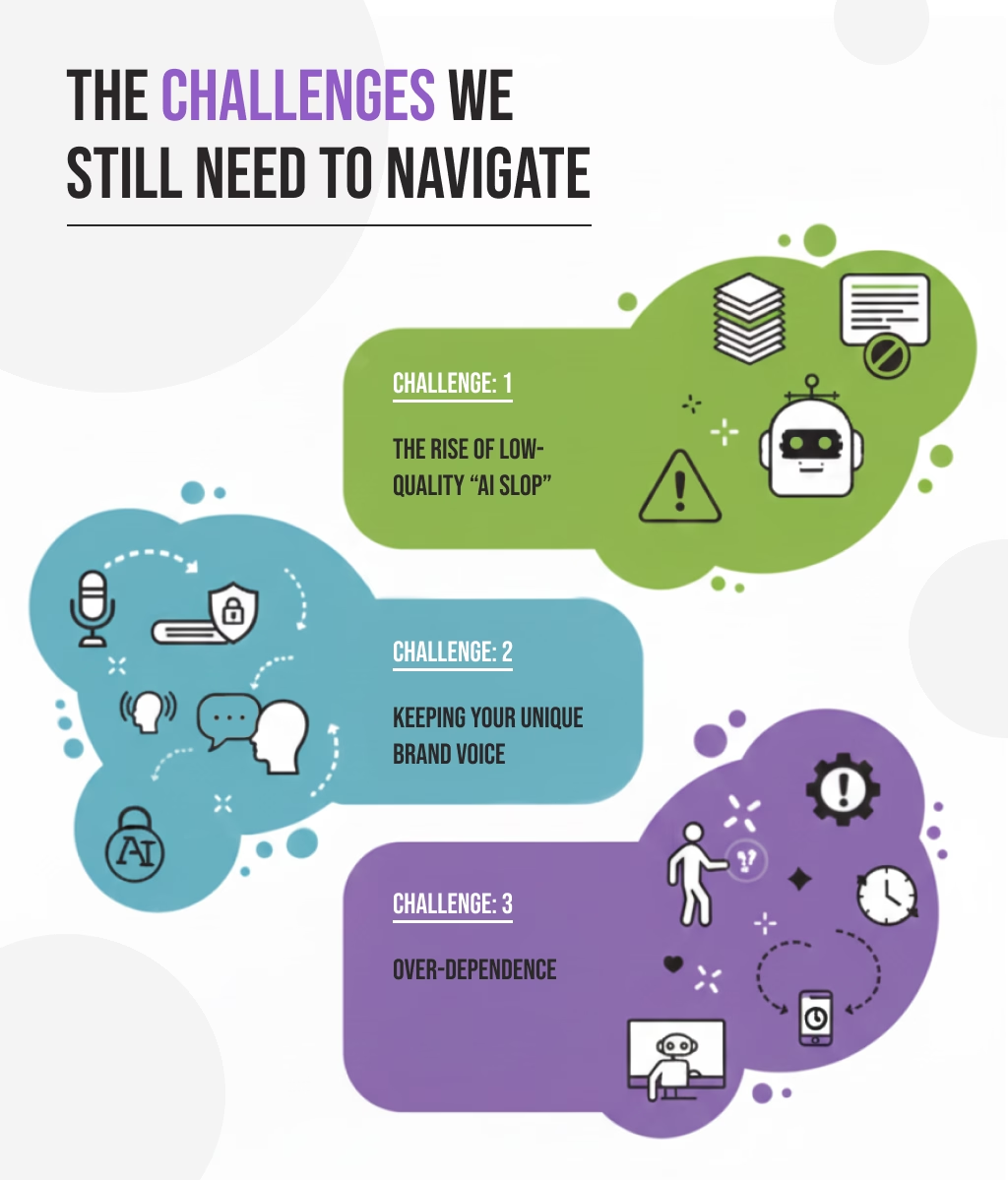
Challenge 1: The Rise of Low-Quality “AI Slop”
As AI tools get easier to use, it’s also getting easier to publish huge amounts of AI-generated blog content that feels shallow, repetitive, or downright useless. This is what many people now call “AI slop” content that technically fills a page but doesn’t truly help the reader.
The danger?
- Search engines are getting better at detecting low-value content
- Readers lose trust when they sense “robotic” writing
- Your brand starts to blend in with every other generic blog
So, quality control becomes a must. Instead of letting the tool do everything, treat AI as the first draft assistant. You still need to:
- Check AI content accuracy and quality
- Add real insights, examples, and personal experience
- Edit for clarity, flow, and relevance
AI can speed up the evolution of content creation, but only if we pair it with human judgment.
Challenge 2: Keeping Your Unique Brand Voice
Another big risk in the future of AI content creation is sameness.
When everyone uses similar prompts and models, you start seeing the same phrases, structures, and ideas everywhere.
That’s bad news for brand identity.
Your brand voice is built from your stories, values, and personality, something even advanced AI algorithms can’t truly replicate on their own. If you rely too heavily on generic outputs, your content may lose the emotion and nuance that come from AI in creative writing paired with real human experience.
The solution is human-AI collaboration:
- Use AI to handle structure, research, and first drafts
- Use you to shape tone, storytelling, and point of view
- Create custom prompts that reflect your brand’s style and audience
Think of AI as a talented ghostwriter that still needs your direction.
Challenge 3: Over-Dependence
Finally, there’s the challenge almost no one talks about enough: becoming too dependent on AI.
When content creation automation feels so convenient, it’s tempting to let it do everything: ideas, strategy, and execution. But if you lean too far into automated copywriting, a few problems creep in:
- You stop training your own writing and strategic thinking
- You may publish content that doesn’t truly match your audience’s needs
- Your content calendar becomes quantity-first, quality-second
In the long run, this weakens your brand instead of strengthening it.
The healthiest way forward is balance:
- Let AI speed up tasks that are repetitive and technical
- Keep humans in charge of positioning, strategy, and direction
- Regularly step back and ask: “Does this content still sound like us, and serve our goals?”
As the role of AI in digital marketing grows, the creators who win won’t be the ones who automate everything. They’ll be the ones who use AI as a powerful assistant without giving up their creativity, critical thinking, or control.
How to Choose a Future-Proof AI Content Tool
In the context of the future of AI content creation, it’s not enough for a tool to just “generate text.” A truly useful AI content writing tool or WordPress AI plugin should support the whole content journey from idea to publish-ready draft without forcing you to juggle multiple apps and tabs.
Here’s what that looks like in practice.
1. It Starts with SERP-Aware, Audience-Focused Planning
A future-ready tool doesn’t guess what to write; it studies what’s already working.
Ideally, it should:
- Offer a SERP-based outline generator that analyzes top-ranking pages before you even start writing.
- Include AI outline generation so you can turn a topic into a structured, SEO-aligned outline in seconds.
- Provide topic analysis for your targeted audience, helping you understand what your readers actually care about, not just what keywords exist.
This way, you’re not just producing content; you’re producing content with a clear purpose and direction.
2. It Guides You Through Long-Form Content, Step by Step
Long-form content often falls apart in the middle. A strong AI content tool helps you stay on track with a guided long-form blog workflow.
Along the way, you should be able to:
- Define advanced blog parameters such as audience, purpose, tone, and more, so each piece is aligned with your strategy.
- Generate and regenerate titles to test different hooks and angles without starting from scratch.
This kind of workflow feels less like random prompting and more like following a clear, repeatable process.
3. It Understands and Adapts to Your Brand Voice
As the future of AI content creation evolves, one of the most important factors will be how well tools handle brand identity.
Look for features like:
- Brand voice training using text snippets or existing WordPress content, so the AI can learn how you typically sound.
- Section regeneration with custom prompts, letting you refine individual parts of a post without rewriting the entire piece.
The goal is simple: faster content, without losing the personality and tone that make your brand recognizable.
4. It Supports Visuals and Social Content, Not Just Text
Content today is multi-format, and tools that only focus on text will feel limited over time.
A future-oriented solution should also:
- Offer AI image generation and regeneration inside WordPress, so you can create or adjust visuals without leaving your editor.
- Provide a streamlined way to create and schedule social media posts, allowing you to repurpose blog content into platform-ready updates.
This keeps your blog, visuals, and social channels aligned as part of one connected system rather than separate, manual tasks.
5. It Connects Directly to Your Publishing Workflow
Finally, the best tools respect your time.
Instead of copying and pasting between platforms, a solid WordPress-focused AI solution will let you:
- Send publish-ready blogs directly to WordPress drafts, preserving formatting and structure.
This closes the loop between ideation, creation, and publishing, making the overall experience feel natural, efficient, and aligned with how you already work.
An AI writing tool like WriteRush is built around this kind of end-to-end experience. It combines SERP-based outline generation, guided long-form workflows, audience and tone controls, brand voice training, section-level regeneration, AI image creation, social post scheduling, and direct export to WordPress drafts.
In practice, that means it doesn’t just help you write faster; it helps you align every piece of content with your audience, your strategy, and the wider future of AI content creation you’re preparing for.
What’s Next? A Look at the AI Content World in 2030
If we fast-forward a few years, the future of AI content creation won’t just be about writing faster; it’ll be about how content lives, evolves, and connects with people in smarter ways.

Let’s imagine what that might look like based on where things are already heading.
1. AI-Driven Content Campaigns
Instead of treating each blog post, social caption, and email as separate tasks, AI-driven content campaigns will handle everything as one connected system.
You might plan a topic once, and generative AI for bloggers will help you:
- Create a long-form blog post
- Turn it into email sequences
- Generate social media posts
- Suggest landing page copy
All of this will be supported by content creation automation and AI-enhanced SEO optimization, so your campaigns are not just creative but also search-friendly from day one.
2. Self-Updating Blog Posts
Imagine publishing a blog and knowing it won’t “go stale” in six months.
In the future, many AI-generated blog content pieces will be set up to update themselves. Using advanced AI algorithms, your posts will:
- Refresh stats and outdated examples
- Adjust headings and structure for better readability
- Align with new search trends automatically
This kind of self-maintaining content is a natural step in the evolution of content creation.
3. Full Dynamic Personalization
Right now, most readers see the same version of a blog. In the future, personalization with AI tools will make content feel tailor-made.
The same article could:
- Show different examples to beginners vs. advanced readers
- Surface different calls-to-action based on behavior
- Adapt tone and length for different devices or locations
Content won’t just be published, it’ll respond to who’s reading it in real time.
4. AI as a True Co-Writer
We’re already seeing human-AI collaboration, but by 2030, AI will feel much more like a real co-writer.
You might rely on AI for:
- Brainstorming angles and outlines
- Drafting AI for long-form blog posts
- Offering alternatives for hooks, intros, or conclusions
Meanwhile, you’ll still shape the story, emotion, and strategy, especially where AI in creative writing needs a human touch.
5. Human Creativity Becomes More Valuable
Here’s the twist: as AI gets better, human creativity doesn’t disappear; it becomes more important.
When anyone can generate decent content, what stands out is:
- Original ideas and perspectives
- Strong brand voice and storytelling
- Clear values and ethical choices in how AI content is used
So, the future of AI content creation isn’t about choosing between humans and machines. It’s about using AI to handle the repetitive work so humans can do what they’re best at: thinking, imagining, and connecting on a deeper level with their audience.
Your Future Is Here, You Just Need to Step Into It!
AI is not replacing bloggers, marketers, or WordPress creators.
It’s empowering them.
The future belongs to those who understand how to use AI smartly, creatively, and strategically, not those who ignore it.
Your AI content writing tool or WordPress AI plugin isn’t just a feature; it’s a future-proof writing companion that lets you:
- Write faster
- Publish smarter
- Stay ahead of competitors
- Focus on creativity, not drudgery
If you’re ready to future-proof your content creation process, there’s no better time than now.
Just imagine what your blog will look like 6 months from today…
More consistent.
More optimized.
More impactful.
That’s the power of embracing the future, TODAY.
FAQs: AI Content Creation and the Future
What is AI content creation?
AI content creation uses artificial intelligence tools to generate text, images, videos, or designs, helping businesses scale content faster and more efficiently.
Will AI replace human writers and creators?
No. AI can automate repetitive tasks, but human creativity, storytelling, and strategy remain essential. The future is human plus AI collaboration.
What are the benefits of AI in content marketing?
AI enables faster production, personalization at scale, cost savings, and better SEO optimization, helping brands compete more effectively.
What are the risks of AI-generated content?
Challenges include misinformation, copyright issues, plagiarism concerns, and loss of authenticity if not managed carefully.
What does the future of AI content creation look like?
The future includes multimodal AI (text, image, video, audio), immersive content in AR/VR, dynamic storytelling, and new regulations to ensure ethical use.
This page was last edited on 18 December 2025, at 11:05 am