
Have you ever looked at your content calendar and felt a wave of quiet panic?
Deadlines are stacking up. Blog posts are being rushed. Editors are overwhelmed. SEO performance is slipping. And somehow, the more content you publish, the less confident you feel about its quality.
You’re not alone.
Scaling content sounds exciting until quality starts breaking down. Brand voice becomes inconsistent. Articles feel repetitive. Review cycles get messy. AI content marketing tools produce drafts, but no one has time to refine them properly.
Here’s the truth: volume doesn’t kill quality, lack of systems does.
In this guide, you’ll learn how to maintain content quality in high-volume production using structured editorial workflows, SOPs, measurable KPIs, AI-human collaboration, and smart WordPress publishing systems. Whether you’re a blogger, content marketer, or agency scaling output, this framework will help you grow without losing standards.
Let’s fix the chaos.
Why Content Quality Breaks Down at Scale
Before you can fix quality issues, you have to diagnose them.
When content output increases, weaknesses in your system become visible almost overnight. What worked for publishing five blog posts per month often collapses when you scale to fifty. That’s not a talent problem, it’s a structural one.
In scalable content operations, small gaps in your editorial workflow quickly turn into systemic quality issues.
The Most Common Reasons Quality Drops
When teams scale too fast, these breakdowns are predictable:
- No defined SOPs (Standard Operating Procedures)
Without clear documentation, writers interpret content briefs differently. One article follows the brand voice perfectly. The next feels off-tone. Over time, inconsistency becomes the norm. - Weak editorial workflow
If your content production pipeline doesn’t include clear review and approval stages, drafts move forward without proper quality assurance (QA). Editorial quality control becomes reactive instead of structured. - Inconsistent brand voice
Without a documented style guide or content governance framework, maintaining brand consistency at scale becomes nearly impossible. Every writer brings a slightly different tone. - AI misuse without human-in-the-loop editing
AI content tools can accelerate drafting, but when AI-generated content skips proper review, factual errors, tone shifts, and SEO inconsistencies slip through. AI content validation requires human oversight. - No measurable benchmarks
If “quality” isn’t tied to defined KPIs, like engagement metrics, revision cycles, or SEO consistency at scale, it becomes subjective. And subjective standards don’t scale. - Fragmented collaboration systems
Slack for feedback. Google Docs for drafting. Email for approvals. WordPress CMS for publishing. When tools aren’t integrated, workflow automation breaks down, and accountability suffers. - No clear content governance model
When nobody owns the standards, nobody protects them. Governance ensures someone is responsible for E-E-A-T alignment, editorial compliance, and long-term authority building.
Why Small Gaps Become Big Problems
Here’s what often happens.
A team publishing five articles per month misses one review step. It’s manageable. An editor catches it later.
Now scale that same team to fifty articles per month.
That single missed step multiplies across the content lifecycle management process. Suddenly:
- Brand voice becomes diluted
- SEO structure becomes inconsistent
- Errors go live
- Editors burn out
Scaling doesn’t create chaos; it reveals it.
High-volume publishing magnifies inefficiencies in your content production pipeline. What once felt like a minor oversight becomes a recurring flaw in your scalable content operations.
That’s why learning how to maintain content quality in high-volume production isn’t about working harder.
It’s about building structure.
Structure in your editorial workflow.
Structure in your QA checkpoints.
Structure in your governance model.
Because speed without systems doesn’t scale quality, it scales mistakes.
Establish Clear Quality Benchmarks and KPIs
If you can’t measure quality, you can’t maintain it, especially when you’re scaling content production.
One of the biggest mistakes teams make in high-volume publishing is assuming that “good writing” is enough. It isn’t. When output increases, quality must shift from being subjective to being operational.
In scalable content operations, quality needs clear definitions, measurable standards, and repeatable quality assurance (QA) checkpoints built into your editorial workflow.
So what does “quality” actually mean in modern content marketing?
Content Quality Is More Than Writing
In the context of maintaining content quality in high-volume production, quality includes:
- Accuracy and factual integrity: Every claim must be verified. In a structured content production pipeline, fact-checking should be a formal QA step, not an afterthought.
- SEO consistency at scale: Content must align with search intent, structured headings, semantic relevance, and internal linking. Maintaining SEO consistency at scale requires documented SOPs and clear optimization guidelines.
- Strong E-E-A-T signals: Expertise, Experience, Authoritativeness, and Trustworthiness should be visible in every piece. This includes citing credible sources, demonstrating subject-matter depth, and avoiding shallow AI-generated filler.
- Clear structure and readability: Scannable formatting, logical flow, and strong subheadings improve both user engagement and Answer Engine Optimization (AEO).
- Brand voice alignment: Maintaining brand consistency at scale depends on enforcing style guides and editorial quality control. Without content governance, tone quickly becomes inconsistent across writers.
- Engagement and conversion performance: High-quality content doesn’t just inform, it performs. Metrics like time on page, scroll depth, and conversion rate help determine whether your content truly resonates.
Turning “Quality” Into Measurable Benchmarks
Here’s the key shift: quality must move from opinion to data.
For example, instead of saying, “This article feels strong,” define measurable checkpoints inside your workflow automation system:
- Has the article passed editorial review?
- Does it meet the defined readability score?
- Are target entities and semantic signals naturally integrated?
- Has SEO metadata been validated in your WordPress CMS?
- Has a human-in-the-loop editing stage approved AI-assisted sections?
These checkpoints transform quality into a process, not a guess.
In high-volume content lifecycle management, even small inconsistencies compound. But when benchmarks are clearly defined and embedded into your SOPs, maintaining brand authority becomes sustainable, even as your publishing velocity increases.
What Defines Content Quality?
When you’re publishing one or two pieces a week, quality can feel intuitive. An experienced editor reviews the draft, makes a few adjustments, and hits publish.
But when you’re operating inside scalable content operations, intuition isn’t enough. Quality must be clearly defined, documented, and measurable. Otherwise, your content production pipeline becomes inconsistent, and inconsistency is the fastest way to dilute authority.
So what does “content quality” actually mean in high-volume production?
At a strategic level, quality is the alignment between your content, your audience, and your standards. At an operational level, it’s the result of a structured editorial workflow, strong quality assurance (QA), and clearly defined SOPs.
To operationalize quality, ask:
- Does every article follow a documented editorial checklist?
- Is the brand voice consistent across writers and formats?
- Is search intent fully satisfied, not just mentioned?
- Are headings structured for AEO and semantic SEO clarity?
- Does the content support E-E-A-T through accuracy and expertise?
- Is optimization balanced, avoiding keyword stuffing while maintaining SEO consistency at scale?
- Has AI content validation been followed by human-in-the-loop editing?
These questions transform “quality” from a vague concept into a repeatable system.
Example KPI Framework for Content Quality
When you’re trying to maintain content quality in high-volume production, “quality” can’t be vague. It has to be measurable.
That’s where a clear KPI framework becomes essential. The right metrics help you monitor both your editorial workflow health and your actual content performance, so problems are spotted early, not after rankings drop.
Below is a refined KPI structure you can use inside your content production pipeline.
| KPI Category | Example Metric | Why It Matters |
|---|---|---|
| Production Efficiency | Time to publish | Identifies workflow bottlenecks |
| QA Effectiveness | Revision cycles per post | Tracks editorial clarity |
| SEO Performance | Keyword ranking movement | Measures search alignment |
| Engagement | Avg. time on page | Indicates content depth |
| Conversion | Lead conversion rate | Shows business impact |
| Brand Consistency | Style deviation flags | Protects voice integrity |
Pro Tip: Define both process KPIs (workflow health) and performance KPIs (content effectiveness).
When benchmarks are clear, maintaining brand consistency at scale becomes realistic, not aspirational.
Build a Scalable Editorial Workflow
If content quality is the goal, your editorial workflow is the system that protects it.
In high-volume publishing, quality doesn’t decline because people stop caring. It declines because there’s no structured content production pipeline guiding ideas from concept to publication. Without a defined workflow, quality assurance (QA) becomes reactive instead of preventive.
And when QA is reactive, mistakes slip through.
A scalable editorial workflow ensures that every piece of content moves through consistent stages, regardless of volume. It creates repeatability. And repeatability is what enables maintaining brand consistency at scale.
What a Strong Content Production Pipeline Looks Like
At its core, a high-functioning content lifecycle management system includes clear, sequential stages:
- Topic Ideation: Based on search intent, keyword research, and audience needs
- Content Brief Creation: Including primary entities, SEO goals, and structural outline
- Draft Development: Written according to SOPs and brand voice guidelines
- Editorial Review: Structural, clarity, and factual accuracy checks
- SEO Validation: Metadata, headings, internal links, semantic alignment
- Brand Voice & E-E-A-T Check: Tone consistency, authority signals, experience depth
- Final Approval: Sign-off from the responsible stakeholder
- Publish in WordPress CMS: With structured formatting and optimization
- Post-Publication Audit: Performance monitoring and update scheduling
Each stage should include:
- Clear role ownership
- Defined approval criteria
- Accountability tracking
- Documented SOPs
Without this structure, scalable content operations quickly become chaotic.
Key Roles in High-Volume Content Production Cycle
Imagine a team publishing 40-50 articles per month.
If no one owns SEO validation, metadata becomes inconsistent.
If no one is responsible for brand voice alignment, tone starts drifting.
If editorial quality control is informal, revision cycles multiply.
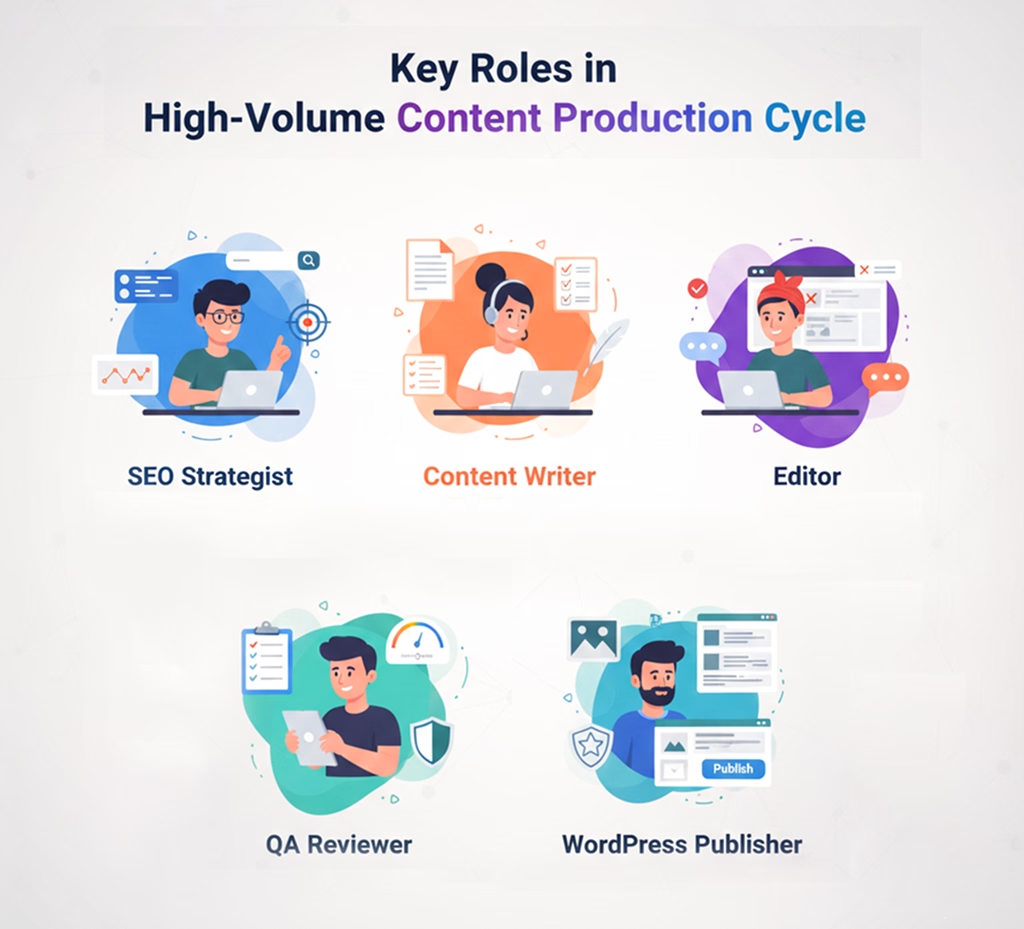
A structured workflow typically includes:
- SEO Strategist: Defines keyword targeting and search intent alignment
- Content Writer: Develops draft based on the brief and SOP
- Editor: Ensures clarity, structure, and authority
- QA Reviewer: Checks compliance with checklist and quality benchmarks
- WordPress Publisher: Final formatting and CMS optimization
When responsibilities are clearly defined, workflow automation becomes possible, and bottlenecks become visible before they damage quality.
Centralizing Workflow Inside WordPress
One of the biggest threats to maintaining content quality in high-volume production is tool fragmentation.
When drafts move between Google Docs, Slack, email, spreadsheets, and disconnected approval threads, editorial governance weakens. Feedback gets lost. Version control becomes messy.
That’s why many WordPress teams use tools that embed workflow automation directly into the WordPress CMS.
Instead of content floating across platforms, every stage lives inside the publishing environment.
For example, integrating AI-assisted review tools within WordPress can:
- Flag missing headings or structural gaps
- Suggest SEO metadata improvements
- Highlight readability or clarity issues
- Validate keyword placement for SEO consistency at scale
- Log editorial comments in context
- Support human-in-the-loop editing
Notice what this does.
It doesn’t replace editorial judgment.
It strengthens editorial quality control.
Use SOPs and Templates to Standardize Quality
If every article begins with a blank page and a vague brief, scaling becomes risky fast.
When you’re producing content at volume, inconsistency isn’t random; it’s structural. One writer emphasizes storytelling, another prioritizes SEO, and a third skips internal linking entirely. Without clear standard operating procedures (SOPs) and repeatable templates, your editorial workflow turns into improvisation.
And improvisation doesn’t scale.
Why SOPs Matter in High-Volume Production
SOPs protect your content production pipeline by reducing variability. They define:
- What must happen before drafting begins
- How editorial quality control is performed
- Who approves what, and when
- How brand voice and SEO consistency at scale are enforced
In scalable content operations, clarity beats creativity at the systems level.
Creativity thrives inside structure, not in its absence.
Example: Structured Content Brief Template
Here’s a practical framework you can adapt:
Topic:
Primary Keyword:
Search Intent: (Informational / Transactional / Comparative)
Target Audience:
Core Entities to Include:
Internal Links to Add:
Content Structure (Proposed H2s):
SEO Focus (Snippet Opportunities, FAQs):
CTA Direction:
Quality Checklist (Before Publishing)
- Meets search intent clearly and completely
- Optimized for featured snippets and AI readability
- Aligns with brand voice guidelines
- Includes strategic internal linking
- Passes editorial review
- Validated for SEO metadata
- Approved under content governance standards
This type of structured brief strengthens your editorial workflow and ensures every article aligns with your broader content lifecycle management strategy.
It also makes collaboration easier, especially when multiple writers and editors are involved.
Pro Tip: Batch Production Strategically
Batching is one of the simplest ways to improve scalable content operations without lowering quality.
Instead of switching between formats constantly, group similar content types:
- FAQ posts
- Comparison guides
- Tutorials
- Case studies
- Product explainers
When teams batch effectively, they:
- Maintain tone consistency
- Reuse research efficiently
- Improve editorial quality control
- Reduce mental fatigue
Batching also simplifies AI content validation because structural expectations stay consistent.
Integrate AI without Compromising Quality in Content Production
AI content tools are incredibly powerful. They can speed up research, generate structured drafts, and even optimize content for search engines in seconds.
But here’s the catch: without content governance and editorial quality control, AI can quietly dilute your authority.
When drafts are published without proper review, brand voice weakens. SEO alignment becomes mechanical. Subtle inaccuracies slip through. And over time, your E-E-A-T signals suffer.
The solution isn’t avoiding AI.
It’s implementing human-in-the-loop editing within a structured editorial workflow.
In scalable content operations, AI should enhance your content production pipeline, not replace editorial judgment.
Where AI Adds Real Value
Used strategically, AI content tools can strengthen workflow automation and improve consistency across high-volume publishing environments.
Here’s where AI genuinely helps:
- Outline generation aligned with search intent
- Draft acceleration for faster first versions
- SEO metadata suggestions (titles, descriptions, headers)
- Readability improvements for clearer structure
- Quality scoring systems that flag keyword gaps
- Grammar and clarity validation
- Content refresh suggestions for aging posts
- AI content validation checks before publication
For example, when scaling inside a WordPress CMS, AI can assist in generating structured drafts directly within your editorial workflow, reducing the friction between ideation and execution.
This speeds up production without lowering standards, if oversight remains in place.
Where Humans Must Lead
AI can optimize the structure. But it cannot replicate strategic judgment or lived experience.
In maintaining content quality at scale, humans must remain responsible for:
- Brand voice calibration and tone consistency
- Strategic positioning within broader content marketing goals
- Experience-driven insights that strengthen authority
- Final QA approval before publishing
- Fact verification and source validation
- Emotional tone refinement and audience alignment
This is especially critical when maintaining brand consistency at scale. Even the best AI content tools cannot intuitively protect a company’s voice without human guidance.
AI as a Workflow Assistant, Not a Replacement
If you’re publishing high volumes of content in WordPress, integrating AI as part of your content lifecycle management can dramatically improve efficiency.
Many WordPress teams use tools that:
- Enforce checklist completion before publishing
- Flag SEO inconsistencies automatically
- Log editorial comments inside the CMS
- Score content based on readability and keyword alignment
- Suggest updates for declining posts
These features support scalable content operations by embedding quality assurance (QA) directly into the editorial workflow.
But the pattern remains clear:
- AI supports workflow automation.
- Humans safeguard authority.
When AI accelerates drafting, and humans protect editorial standards, you preserve SEO consistency at scale while strengthening E-E-A-T signals.
That balance is what allows you to maintain content quality in high-volume production without sacrificing credibility, brand integrity, or long-term authority.
Implement Content Governance and Brand Control
Content governance is one of the most overlooked pillars in scalable content operations, yet it’s one of the most important.
When teams focus only on publishing faster, they often ignore the systems that protect quality. Over time, that lack of structure shows up as inconsistent messaging, uneven editorial standards, and diluted brand voice.
In high-volume production, governance isn’t optional. It’s your safety net.
What Is Content Governance?
Content governance is the structured framework that defines how content is planned, reviewed, approved, updated, and protected across its entire lifecycle.
It ensures that your editorial workflow, quality assurance (QA), and brand standards operate within clear boundaries, especially as your content production pipeline scales.
Strong content governance typically includes:
- Defined brand voice guidelines (tone, terminology, positioning)
- Editorial board or oversight roles responsible for standards
- Role-based publishing permissions inside your WordPress CMS
- Documented SOPs for drafting, editing, and approvals
- Content audit schedules for ongoing optimization
- Escalation paths for sensitive or high-risk content
When these systems are documented and enforced, maintaining brand consistency at scale becomes far less chaotic.
It becomes predictable.
Why Governance Matters in High-Volume Production
Without governance, scalable content operations rely too heavily on individual judgment.
And individual judgment varies.
For example:
- One writer interprets the brand voice as conversational.
- Another leans overly technical.
- A third publishes AI-generated drafts with minimal human-in-the-loop editing.
Multiply that inconsistency across 30, 50, or 100 articles per month, and the cracks widen fast.
Governance prevents that drift by creating shared editorial quality control standards that everyone follows.
It transforms content creation from a creative free-for-all into a disciplined system.
Governance and E-E-A-T: The Hidden Connection
Google’s E-E-A-T framework rewards content that demonstrates:
- Expertise
- Experience
- Authoritativeness
- Trustworthiness
But E-E-A-T isn’t achieved by writing one great article.
It’s built through consistency.
Content governance reinforces E-E-A-T by:
- Ensuring consistent expert positioning across topics
- Maintaining factual accuracy through structured QA
- Preventing misinformation or careless AI overuse
- Protecting tone and brand voice across the content lifecycle
- Supporting SEO consistency at scale
When editorial workflow and governance systems are aligned, your authority compounds over time.
Without them, even good content feels fragmented.
Measure, Audit, and Continuously Improve
Even the strongest editorial workflow isn’t “set and forget.”
If you’re serious about learning how to maintain content quality in high-volume production, you have to treat quality as a living system. That means regular iteration, structured content audits, and clear performance benchmarks.
Because here’s the truth: content doesn’t decline overnight. It fades quietly. Rankings slip. Engagement drops. Statistics become outdated. Internal links break. And unless you have a content governance process in place, those issues compound fast.
What a High-Volume Content Audit Should Evaluate
A proper content audit goes beyond checking keyword rankings. It evaluates your entire content production pipeline and editorial quality control process.
At minimum, review:
- SEO performance: Are primary keywords gaining or losing visibility?
- Engagement metrics: Time on page, scroll depth, bounce rate.
- Conversion data: Are readers taking meaningful action?
- Brand voice consistency: Does the tone align with your style guide?
- Technical health: Broken links, outdated metadata, slow load speed.
- Outdated statistics or examples: Are facts still accurate?
- E-E-A-T signals: Is the content still authoritative and trustworthy?
This ensures SEO consistency at scale while protecting long-term authority.
Quarterly Content Audit Checklist
To keep scalable content operations healthy, schedule structured reviews, ideally every quarter.
Use a checklist like this:
- Identify posts with declining traffic or rankings
- Refresh outdated sections with new data or examples
- Improve internal linking for stronger topical authority
- Re-optimize headings for search intent alignment
- Re-validate on-page SEO structure (title tags, meta descriptions, schema)
- Reassess E-E-A-T signals and credibility markers
- Confirm brand voice consistency across updates
Pro Tip: Separate performance audits (SEO, engagement) from quality audits (accuracy, tone, governance compliance). Both matter.
Conclusion
Maintaining content quality in high-volume production isn’t about slowing down.
It’s about building smarter systems.
When you combine:
- Clear benchmarks
- Structured editorial workflows
- Defined SOPs
- Content governance
- Responsible AI integration
- Ongoing audits
You create scalable content operations that protect authority.
And if you’re using WordPress, integrating the right AI-assisted workflow tools directly into your publishing system can dramatically simplify review cycles, enforce QA, and maintain SEO consistency at scale.
The goal isn’t just more content.
It’s better content, consistently.
Build systems that protect your standards, and growth will follow naturally.
Frequently Asked Questions (FAQs)
How do you scale content without losing quality?
You scale content by building structured editorial workflows, defining clear SOPs, implementing QA checkpoints, and using AI tools with human oversight. Systems do not speed up quality.
What is content quality control?
Content quality control is the structured process of reviewing, editing, and validating content against defined standards such as brand voice, SEO alignment, accuracy, and E-E-A-T compliance before publication.
What metrics measure content quality?
Content quality is measured using both process KPIs (time to publish, revision cycles) and performance KPIs (engagement rate, keyword rankings, conversion rate, bounce rate).
How often should content be audited?
High-volume publishers should perform light audits monthly and full strategic audits quarterly to maintain SEO consistency and brand authority.
How do you maintain brand voice at scale?
Maintain brand voice by enforcing style guides, embedding QA checklists, using structured content briefs, and ensuring human editors validate tone consistency, even when AI tools assist.
How can AI be used responsibly in content production?
AI should assist with drafting, formatting, and optimization, but humans must control strategy, final edits, fact-checking, and brand voice alignment.
This page was last edited on 26 February 2026, at 10:07 am